AI Doesn’t Eliminate Technical Debt—It Amplifies It
Data expert Craig Mullins explains why decades of shortcuts become tomorrow's AI failures as organizations reckon with poor data quality

Over time, organizations accumulate technical debt in their data environments. Sometimes it was intentional. Deadlines had to be met. Budgets were limited. Projects were understaffed. A shortcut taken today could always be fixed later. Except later rarely came.
The result is an accumulation of compromises: poorly documented databases, inconsistent business definitions, duplicate data stores, outdated integration processes, weak metadata and application logic that nobody fully understands anymore.
Historically, many of these issues remained manageable. Systems continued to process transactions. Reports were generated. Customers were served. The business moved forward.
Then AI arrived.
Many executives view artificial intelligence as a solution to organizational complexity. The expectation is that AI can extract insights from massive volumes of data, automate decision-making, and compensate for limitations in existing systems.
The reality is often quite different.
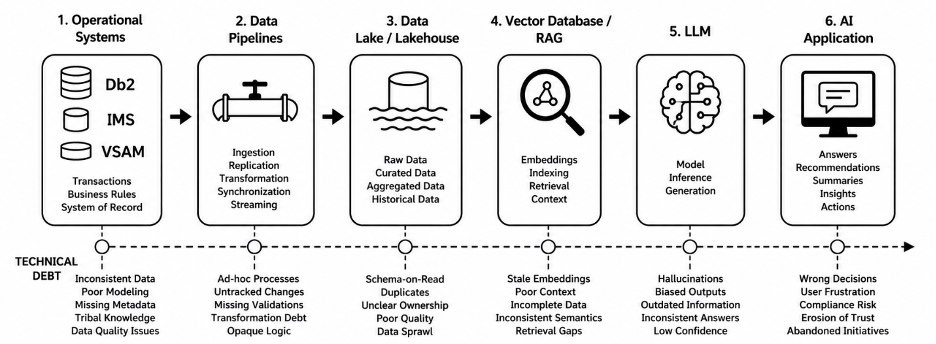
The AI supply chain can pick up technical debt at any point as data propagates through it. See Figure 1. Technical debt introduced at any point is amplified at every subsequent stage. This results in unreliable AI outcomes and erodes trust. In other words, AI does not eliminate technical debt. In many cases, it amplifies it.
Technical Debt Has Always Been a Data Problem
When people discuss technical debt, they frequently focus on application code. Legacy programs, aging frameworks and unsupported software versions tend to receive the most attention. But some of the most damaging technical debt resides in the data environment. Consider a few common examples:
- A customer exists under multiple identifiers in different systems.
- Product definitions vary between departments.
- Critical business rules are embedded in application programs rather than documented centrally.
- Data lineage is poorly understood or not understood at all.
- Database columns contain values that no longer match their original definitions.
- Metadata repositories are incomplete or out of date.
None of these problems are new. Organizations have operated with them for years. The difference is that traditional applications generally perform narrowly defined tasks. An order-entry application processes orders. A billing system generates invoices. A payroll application calculates compensation.
AI systems are different. They consume information from multiple sources, combine it, interpret it, and generate outputs that may influence business decisions. As a result, they encounter the inconsistencies and ambiguities that have accumulated throughout the enterprise.
In effect, AI becomes the first technology initiative that attempts to understand the entire organization’s data landscape.
Unfortunately, many organizations discover that their data landscape is far messier than they realized.
AI Inherits Every Data Quality Problem
One of the most persistent myths surrounding AI is that modern models can somehow overcome poor data quality. But they cannot.
An AI model may be capable of recognizing patterns, summarizing information and generating sophisticated responses. However, it remains dependent on the quality of the data supplied to it. AI cannot magically fix your data:
- If customer records are inconsistent, AI will inherit that inconsistency.
- If business definitions conflict across systems, AI will inherit those conflicts.
- If data pipelines introduce errors, AI will consume those errors.
- If governance is weak, AI outputs become less trustworthy.
The old principle of “garbage in, garbage out” remains valid. AI simply amplifies the process. In some cases, the consequences are even more significant because AI-generated recommendations can appear authoritative despite being based on flawed information. That is, a poorly written report might be questioned, but a confidently delivered AI response may not be.
That distinction matters.
The Hidden Debt of Data Movement
Over the past two decades, organizations have created increasingly complex data architectures. Operational databases feed warehouses. Warehouses feed data lakes. Data lakes feed analytics platforms. Analytics platforms feed machine learning environments. Machine learning environments feed AI applications.
Each additional stage introduces new opportunities for inconsistency: data may be transformed incorrectly, business definitions may change, synchronization delays may occur, governance controls may be applied unevenly, and metadata may be lost.
The result is a form of technical debt that is rarely discussed: data movement debt. Every copy of data creates another opportunity for divergence from the original system of record.
AI projects often expose these weaknesses because they depend on integrating information across multiple repositories. When inconsistencies emerge, the AI system becomes the messenger delivering unpleasant truths about the underlying architecture.
Why Systems of Record Matter Again
Modernization discussions frequently focus on moving data away from operational systems. Data gets extracted, replicated, transformed and redistributed to support new applications and analytical workloads. But AI is causing organizations to reevaluate that strategy.
The most valuable data for enterprise AI initiatives is often not found in public data sets or external repositories. It resides in systems that have been collecting and validating business transactions for decades.
These systems of record contain the information organizations trust most:
- Customer transactions
- Financial records
- Inventory balances
- Policy information
- Claims history
- Account activity
- Supply chain events
The quality of AI outcomes increasingly depends on the quality of these foundational sources.
This does not mean organizations should abandon modern architectures. It does mean they should recognize that trusted operational data has become a strategic asset rather than a legacy burden.
The New Cost of Ignoring Technical Debt
In the past, technical debt often manifested as higher maintenance costs, longer development cycles or occasional operational disruptions. AI changes the equation. Today, technical debt can directly affect:
- AI accuracy
- Regulatory compliance
- Customer trust
- Operational efficiency
- Decision quality
- Competitive advantage
An organization with poorly governed data may spend millions on AI initiatives only to discover that the underlying information cannot support reliable outcomes.
The AI project itself may not fail because of model selection, computing infrastructure or prompt engineering. It may fail because nobody addressed decades of accumulated data debt.
IBM Z and Db2: Technical Discipline Becomes an AI Advantage
For a long time now, the industry conversation has centered on modernizing away from the mainframe. The assumption has been that innovation required moving data to newer platforms where analytics and AI could flourish. While new platforms certainly have their place, AI is forcing organizations to reconsider where their most valuable data actually resides.
For many enterprises, the answer is IBM Z.
Every day, IBM Z systems process millions of business-critical transactions with remarkable reliability. The Db2 databases supporting those workloads weren’t designed with generative AI in mind, but they were engineered around principles that AI now depends upon: data integrity, consistency, concurrency, security, recoverability, auditability and governance.
These aren’t glamorous attributes and they rarely make headlines. Yet they determine whether an AI application can produce answers that business leaders are willing to trust.
The irony is hard to miss. Practices that some viewed as old-fashioned—careful data modeling, referential integrity, standardized definitions, disciplined change management and rigorous database administration—are proving to be essential building blocks for successful AI initiatives. What once seemed optional and was treated as operational overhead is now a competitive advantage.
This is also changing the role of the DBA. Database professionals are no longer responsible solely for keeping systems available and SQL running efficiently. They are increasingly becoming stewards of the trusted data that fuels enterprise AI. Every decision about schema design, metadata, indexing, security, retention and governance now has implications far beyond operational applications. It influences the quality of AI-generated insights as well.
Perhaps the biggest lesson is this: AI does not diminish the importance of IBM Z and Db2. It elevates it.
As organizations race to deploy intelligent applications, they are discovering that the strongest AI supply chains begin not with the latest large language model, but with trusted systems of record. In many large enterprises, those systems continue to run on IBM Z with Db2 at their core.
The companies that recognize this won’t view their mainframe as yesterday’s infrastructure. They’ll recognize it as one of their most strategic AI assets.
What Organizations Should Do Next
The rush to deploy AI has created pressure to move quickly. That pressure is understandable because competitive markets reward innovation. But organizations should resist the temptation to view AI as a shortcut around fundamental data management disciplines.
Successful AI initiatives increasingly require:
- Strong data governance
- Accurate metadata
- Clear business definitions
- Trusted systems of record
- Effective data quality controls
- Well-managed integration processes
- Documented lineage and ownership
These practices are not new. In fact, they represent many of the same principles database professionals have advocated for decades. The difference is that AI has transformed them from best practices into business necessities.
The organizations that achieve the greatest value from AI will not necessarily be those with the largest models or the most advanced algorithms. They will be the organizations that have done the hard work of understanding, governing and trusting their data.
Because in the age of AI, technical debt does not disappear.
It becomes visible.