From Noise to Intelligence: How Taxonomy Is Essential to AI for Mainframe Operations
For the first article in their series, "Rise of the Agents," Clea Zolotow, Marci Formato and Alfredo Iglesias of Kyndryl discuss why flooding AI systems with unstructured or poorly classified information is insufficient
Author’s note: This article is the first in the series, “Rise of the Agents.” The insights shared here were initially presented in March at SHARE 2026, to an engaged and dynamic audience eager to explore the latest advancements in mainframe technology.
The conversations underscored the novelty and excitement surrounding AI’s role in mainframe operations—a space where artificial intelligence is just beginning to reshape how critical systems are managed and optimized. As mainframe professionals seek practical ways to harness AI, the need for foundational concepts like data taxonomy has never been more apparent.
Mainframes continue to support the world’s most critical systems, from financial transactions to national infrastructure. Mainframe platforms remain unmatched in resiliency, throughput and reliability. Yet the way we operate them is under increasing pressure. Complexity is rising, skills are scarce, and expectations for availability, performance and cost transparency continue to escalate. While the platform isn’t legacy, many times the code requires modernization.
Artificial intelligence unlocks a realm of innovation, yet the true magic emerges when it’s woven seamlessly into mainframe operations and combined with human oversight. By crafting a robust data taxonomy, we can transform raw noise into valuable insight to turn scattered information into structured information that powers AI-driven solutions across the mainframe landscape.
Why Agentic AI Matters for Mainframe Operations Today
Traditional automation has helped mainframe teams scale for decades, but much of it was built years ago in an environment where the pace of change was slower, workloads were more predictable and human operators were always in the loop. Today’s mainframes, however, operate inside increasingly dynamic hybrid cloud environments with constant change driven by DevOps pipelines, regulatory demands and business volatility.
Agentic AI represents a fundamental shift in how organizations operate. Rather than simply executing predefined rules or relying on institutional knowledge, AI agents can observe, reason and act to drive business impact—all with humans in the loop and within clear guardrails that support trust and explainability. By correlating signals across performance metrics, configuration states, incident histories and application behaviors, AI can continuously learn from outcomes and adapt over time, empowering operations and system teams to work proactively and effectively.
As experienced team members leave mainframe roles, preserving operational expertise becomes crucial for workforce continuity. AI on the mainframe captures, operationalizes and reuses this valuable knowledge in real time. This gives new talent the ability to onboard efficiently and quickly through guided actions, contextual insights and decision support integrated into daily operations. This will augment, but not replace, expert resources while ensuring system stability, resilience and trust while developing the next generation of mainframe talent.
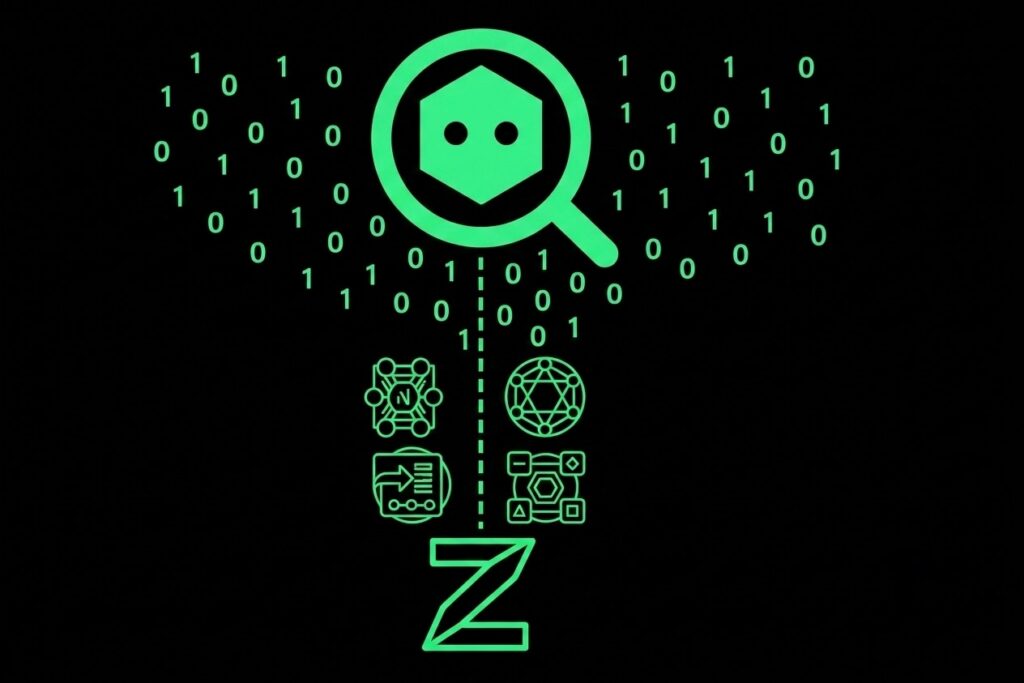
However, AI agents are only as effective as the data they are trained on and have access to reason with. Mainframe environments generate enormous volumes of operational and management data consisting of system telemetry, logs, SMF records, tickets, runbooks, code artifacts and more. Without structure, this data becomes noise, but with the right taxonomy, it becomes intelligence.
A well‑defined data taxonomy allows AI agents to understand not just what information exists, but what it means, how it relates, and how it can be used to optimize delivery and operations. This is the difference between automating tasks and enabling intelligent systems. In practice, it can be tempting to ingest data sources in many different formats and assume AI will “just figure it out.” In mission‑critical environments, “just figure it out” isn’t good enough, as that approach is unlikely to produce reliable, explainable outcomes.
Moving Data From Noise to Intelligence
Conventional automation mostly relies on static rules, brittle integrations and narrow data scopes. It performs well when conditions are known and stable but struggles when environments evolve or signals conflict.
Mainframe operations today are anything but static. Performance anomalies may be linked to application changes, infrastructure shifts, data growth patterns, customer usage patterns or external dependencies. No single rule can capture these dynamics.
AI agents require a richer, more organized view of operational reality. A robust data taxonomy enables:
- Integration of diverse management data types
- Clear separation of inputs, outputs and derived intelligence
- Continuous learning from operational outcomes
- Dynamic decision‑making across system, application and business contexts
Without this structure, organizations fall into the “dump everything” trap—pouring vast amounts of unclassified data into AI systems and hoping insight will emerge. It won’t. Intelligence does not come from volume alone; it comes from meaning.
The Takeaway: Taxonomy Before Intelligence
Achieving real progress with AI in mainframe operations requires discipline before ambition. The goal is not to collect all the data, but to organize the right data in the right way.
A well‑defined data taxonomy:
- Provides a clear organizational framework for information assets
- Improves data quality, governance and relevance
- Enables AI systems to reason, act and learn responsibly and accurately
- Turns mainframes into adaptive, intelligent platforms rather than static infrastructure
Simply flooding AI systems with unstructured or poorly classified information will not deliver actionable outcomes. To unlock the full potential of agentic AI in mission‑critical environment, and to do so responsibly and with human oversight, means taxonomy is not optional. It is foundational.
In the next article, we will ground this discussion in operational reality by examining how mainframe teams work today, where data friction exists and why humans are still forced to manually synthesize Information that AI could reason across in seconds.