Why IBM’s New S1112 Is a Win for AI
Jesse Gorzinski, architect of AI for IBM i, shares the significance of the single-socket IBM Power11 system for on-prem AI
In case you haven’t yet seen the announcement, IBM is offering a single-socket system for IBM Power11. This new system, coined the S1112, brings AI capabilities to the forefront of IBM Power shops.
On the surface, this may seem like a standard generational increment for IBM scale-out servers. In today’s discussion, though, I will talk about why the S1112 represents something much more substantial: a unique AI deployment opportunity for companies of all sizes.
The Basics
Before we get too far into the details, we need to remember a key point: every IBM Power11 processor comes with on-chip Matrix Math Acceleration (MMA) technology, which can provide data-local insights with low latency. That’s right: You can efficiently run AI on-prem while maintaining control of sensitive data and reducing exposure to external risks. No GPUs needed!
With that in mind, let’s take a peek at the S1112. For starters, you can check out the S1112 product page. Here’s a rundown of some classic “speeds and feeds”:
- Four- or 10-core eSCM modules
- Up to 512GB DDR5 DDIMMs memory
- Four PCIe slots
- Up to four NVMe drives
- Up to 12.8 TB total internal storage
- Support for a half I/O drawer for six more PCIe slots
The system is also available in rack-mounted or deskside form factors.
Now, those familiar with IBM’s tiered pricing model know that entry-level systems are classified in the “P05” tier. That lower tier is designed to provide a cost-competitive option for smaller or entry-level companies. As such, IBM i is reasonably capped at 4 cores.
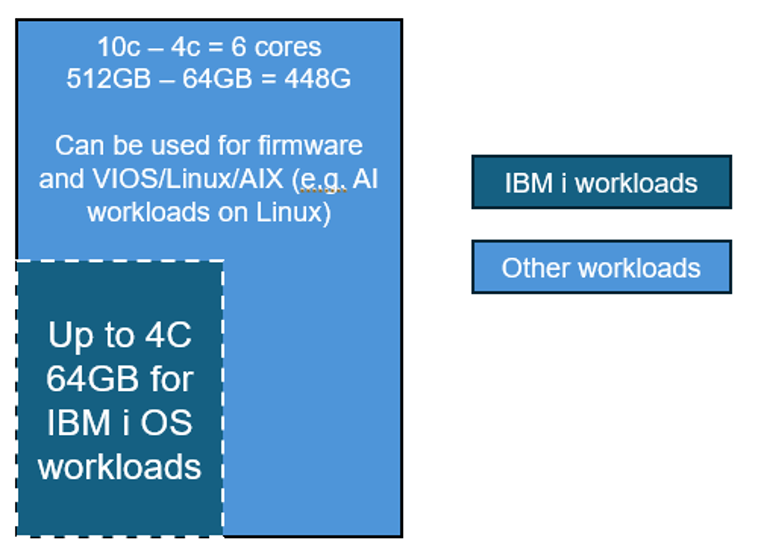
The 10-core model comes with a virtual boundary, illustrated below. This design allows IBM i to consume up to four of those cores. This is a win-win configuration. It enables IBM i shops to have more horsepower for AI and open-source workloads, while retaining the pricing of IBM’s “P05” hardware tier.
Why Is This Such a Big Deal?
With the new 10-core option, the compute not used by IBM i can be used for “other workloads.” It’s now easier than ever to surround IBM i with adjacent Linux-based technology. What types of things make sense in this “sidecar”? The options are limitless! Maybe you could run an HTTP proxy or load balancer. Perhaps a Kafka broker, an observability tool or some other open-source utility.
But remember: Power11 has an on-chip AI inferencing accelerator! So, running some kind of AI on these now-handy cores makes a lot of sense!
Applied AI Workloads
The obvious question at this point is, of course, “what kinds of AI workload can I run?” For starters, we’ve worked closely with several ISVs to certify their software on the S1112’s compute capacity.
One such product is Equitus Video Sentinel (EVS). In short, EVS provides live video analytics. There are many practical use cases for this technology in some of IBM i’s strongest industries, such as retail, trucking, public safety and manufacturing.
Another option is Rocketgraph xGT, described as “an in-memory graph analytics platform designed for high-performance at all scales.” Certain types of workloads are a great fit for this paradigm. Some of the specialized use cases include fraud detection, combating money laundering and vulnerability management.
We’ve also been building a suite of turnkey AI solutions into IBM’s AI Launchpad (also known as “AI Services”).
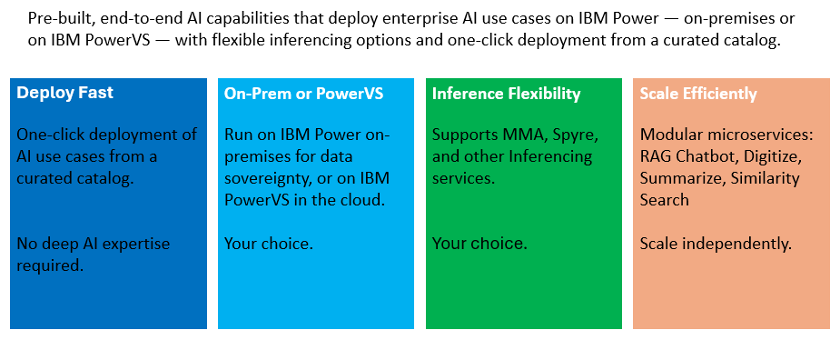
In short, the AI launchpad lets you deploy turnkey AI workloads on your Linux footprint in just minutes! If this sounds interesting, I invite you to check out the video demo on the GitHub project page here.
If you’re looking for more custom solutions, no worries! You’re going to want the Python ecosystem for IBM Power (“PyEco”). This package provides all the key AI libraries that you can use to build your own robust, powerful and customized solution. And yes, of course it will exploit all the AI capabilities of your Power hardware!
As noted by this blog entry, some of the more critical packages include:
- Deep Learning: PyTorch, TorchVision, TorchAudio
- Scientific Computing: NumPy, SciPy, Pandas, Matplotlib, Statsmodels
- Performance: Numba, llvmlite, TBB, Cython
- Computer Vision: OpenCV, Pillow, tesserocr
- NLP & Text: tiktoken, regex, lxml, MarkupSafe
- Data Processing: PyArrow, H5py, array_record, fastavro, sentencepiece
- Database: PyMongo, PyODBC, Snowflake Connector, Cassandra Driver
- Web & Networking: cryptography, greenlet, httptools, multidict, yarl
The takeaway? Even if you’re running an entry-level server, you can still run real AI workloads and capture previously-unexplored business value!
Is the 10-Core Model Right for Me?
To review, the S1112 comes with both four-core and 10-core options. If you’re a P05-tier company, which model is right for you? In my view, there’s a simple question for which there are just a few possible answers: What is my company’s view on AI?
The first option is to declare that AI is rubbish. Your company doesn’t need it, will never need it, and doesn’t want to think about it. If this is the case, perhaps the four-core system is your bet.
Now, if you know your company could use some AI now or in the future, opt for the 10-core model. You’ll have the computational power (with MMA) to deploy AI confidently on your own hardware, without relying on external cloud services and the complexity that comes along with it.
In reality, most companies would answer some form of “maybe.” Perhaps you see the business value but haven’t figured out which use cases to target. Maybe you have some use cases in mind but don’t have an execution plan. In any event, it makes the most sense to be a bit proactive; opt for the 10-core model and be ready to transform the business when the time is right!
What About Medium and Enterprise Companies?
If your company is too large to “fit” into the S1112 offering, you’ll naturally opt for a larger system that’s right for you. In which case, however, it’s still important to plan for possible future growth. All of the AI software that runs on the S1112 (including the AI launchpad) can run on the larger systems, too! And if your future may have some self-hosted AI needs, consider that as you plan your next upgrade.
The S1112 can also be a fine auxiliary system. Some enterprise customers are looking at deploying it as a standalone add-on to their existing infrastructure.
Closing Thoughts
To sum it up, the 10-core S1112 is an exciting new addition to the IBM Power lineup. You’ve got MMA acceleration, computational power and tight affinity with your IBM i partitions. What a win!
Today we focused on Linux-deployed AI solutions, which is natural since the Linux ecosystem is at the forefront of this emerging technology. In many cases, this “sidecar” approach is a great answer. Sometimes, however, it makes sense to just run AI workloads natively on IBM i. In my next blog, I’ll explore that in more detail, so stay tuned!