Future-Proofing IBM i – The New Path to Modernization and Long-Term Durability

Long-term utility and durability form the bedrock of IBM i systems in today’s enterprise landscape. These platforms have powered mission-critical operations for decades, delivering unmatched reliability and scalability.
Yet, as business demands evolve, modernization – rather than outright replacement – remains key to utilizing its full potential.
- By upgrading green screens to modern user interfaces along with analytics and custom dashboards, organizations preserve tailored business logic
- By using modern business intelligence (BI) tools, data reporting is enhanced
- 24×7 IT Infrastructure support keeps the system running while you get peace of mind
This modernization approach follows incremental, low-disruption sprints that minimize cost and operational impact while continuously sustaining and enhancing your competitive edge.
Your investments focus only on what’s essential, with outsourced IBM i (AS/400) expertise safeguarding continuity and reducing risk, keeping systems ready for decades without the disruption of replacing your core platform.
Modernize vs. Replace
Evaluating Cost, Risk and Value
When weighing modernization against replacing an IBM i system with a new application, the motivating factors are cost, risk, and sustained value.
- Modernization shines by retaining customized business processes that drive your current business, minimizing potential hurdles such as functional mismatches and availability.
- Staged rollouts allow zero operational downtime, keeping your business running continuously.
- Only invest in what’s essential – keeping costs and disruption far below that of full system replacements.
- Upsides include reduced employee turnover, lower training costs, increased job satisfaction, and streamlined efficiency.
- Unified data analytics with user-tailored dashboards and robust system support via expert outsourcing enhance business operations and allow key business insights.
In contrast, system replacement promise out-of-the-box features, cutting-edge technology, and broad partner ecosystems.
- However, replacements require entire business process overhauls and intensive training and can lead to the loss of custom logic.
- Significant internal resource commitments follow, with a high risk of budget and timeline overruns.
- Hidden costs include licenses, hardware/cloud setups, migrations, training and unplanned disruptions.
ROI calculations overwhelmingly favor modernization for its incremental nature and more flexible funding. It preserves IBM i’s legendary durability – rock-solid performance without starting from scratch.
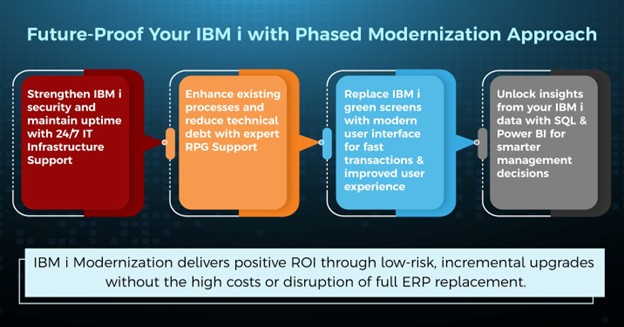
Incremental Approach to
IBM i Green Screen Modernization
Legacy green screens on IBM i platforms lack the user-friendly screens found in fast-paced enterprises. A modern screen modernization strategy can provide targeted upgrades.
Modernization converts keyboard dependent interfaces into sleek, web-based UIs – leaving core application business logic intact, providing intuitive front ends.
Core IBM i Intelligence Tools
Modernization relies on a suite of IBM i Intelligence Tools to understand, stabilize, and update IBM i environments, reducing delivery risks and over-reliance on institutional knowledge.
- Automated system specification analysis delivers non-invasive inventories – including libraries, objects, PTF levels, and hardware details.
- Continuous, proactive system health monitoring tracks performance, capacity trends, anomalies, and resilience threats.
- Secure code download & source integration enables modern source control, documentation, and AI-driven analysis, creating a baseline for future change management.
The modernization process unfolds
via a disciplined 7-phase process
Discover, Define, Design, Develop, Test, Communicate/Train, Deploy
- Discover aligns engagement teams and stakeholders on needs and priorities through need analysis, ROI evaluation, user goals, and stakeholder mapping.
- Define captures business/technical requirements, as-is/to-be processes, and gaps.
- Design creates UX, flows, integrations, prototypes, and UI.
- Develop builds content, UI, integrations, and performs unit testing.
- Test includes running test cases, regression, UAT, and load tests.
- Communicate/Train delivers role-based plans and materials for adoption.
- Deploy launches, secures approvals, rolls out, validates, and hands off.
This blueprint minimizes disruptions and aligns business imperatives
Users see obvious benefits – RPG APIs let you extend existing applications without major rewrites, so you can deliver new functionality quickly. Early wins, like operational dashboards, often provide a fast ROI. The approach also scales well so you can grow capacity as needed and roll features out incrementally, starting with the users who need it most. Using open technologies helps keep licensing costs under control.
This means your IBM i applications can evolve from traditional green screens into systems that support modern analytics and integrations, improving efficiency while keeping the core platform stable and available.
In addition, as you integrate IT Service Management for 24/7 stability including incident response, change controls, problem resolution, you get your IBM i to exceed your expectations.
Your modernization journey can start small with the following:
- A one-day pre-assessment to discover business priorities
- A two-week deep dive to document systems fully
- Lastly, your prioritized recommendations and ROI reports guide our next steps
Payoffs – future-proof operations, minimized turnover/training, elevated satisfaction, turbocharged efficiency. Long-term, the seven step blueprint bolsters IBM i durability, reliability, custom processes, with measured incremental investments.
Leveraging AI
For Quick, Economical Modernization
Beyond modernization, AI can further transform IBM i systems – improving business processes and providing valuable insights. The same seven-phase flow is used to leverage AI screen modernization from daunting to doable – fast and cost-effectively.
Embedded across the seven-phase flow, the AI Toolbox accelerates every step under human expert guidance.
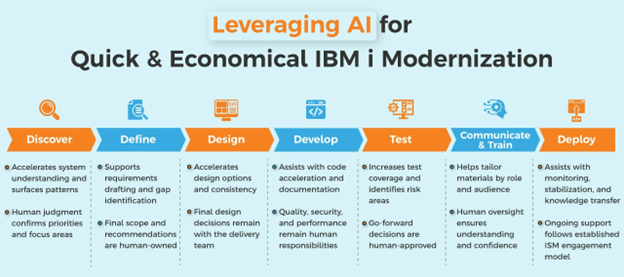
Humans control quality, security, performance, final decisions.
Speed shines with non-invasive insights, swift iterations, proactive risk hunts.
This approach compresses timelines and minimizes expenses via automation. Bypasses new-tool investments, triggers incremental ROI. Human-AI synergy democratizes upgrades for IBM i’s next chapter.
Conclusion
IBM’s Commitment to the Platform
IBM’s ongoing commitment to the IBM i (AS/400) is another reason your investment is safe. The company is committed to regularly releasing updates, patches, and new features, ensuring the platform evolves with changing business needs.
IBM’s focus on hybrid cloud integration, AI capabilities, and advanced analytics has made the IBM i (AS/400) a future-ready solution.
IBM i system enhancements are too valuable to walk away from. These advancements unlock modern development, security, performance, and integration benefits.
Our Commitment to Your IBM i
With IBM i, Db2, and Power platform enhancements, Integrative Systems can help modernize your code and user interfaces, strengthen your platform’s security, enable open-source and modern tooling, optimize performance and provide high availability – so your IBM i environment is future-ready, efficient, and business-aligned.