August TechPulse Recap: Modernization—The Project That Never Ends

For August, TechPulse asked IBM Power professionals about their approach to modernization—how they’re pacing it, where AI tools fit in, what’s actually driving the work and how legacy IBM i forms and documents factor into the picture. Thirteen respondents weighed in, and the results suggest a community that’s largely moved past crisis-mode modernization, even as old bottlenecks around forms and legacy skills persist.
For most, modernization is not a one-off project.
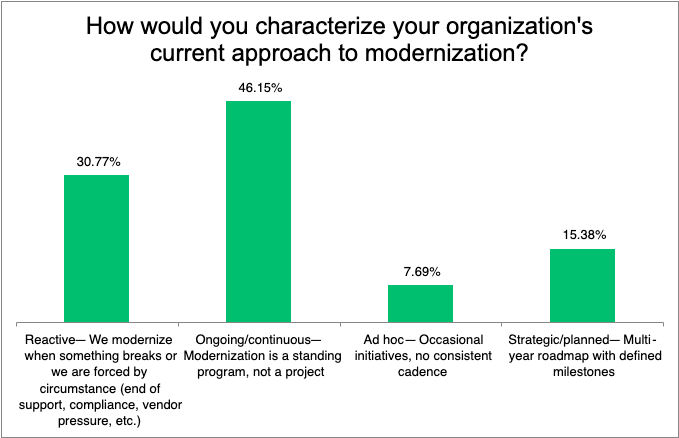
Asked to characterize their organization’s current approach to modernization, six respondents described it as ongoing/continuous, a standing program rather than a one-time initiative. Reactive modernization, done only when something breaks or forces the issue, was the second most common answer, with four respondents choosing that answer. Two of the technologists said their modernization approach was “strategic/planned,” with a defined multi-year roadmap. Just one respondent called their approach ad hoc, with no consistent cadence.
AI tools are gaining traction for modernization work, but full integration is still rare.
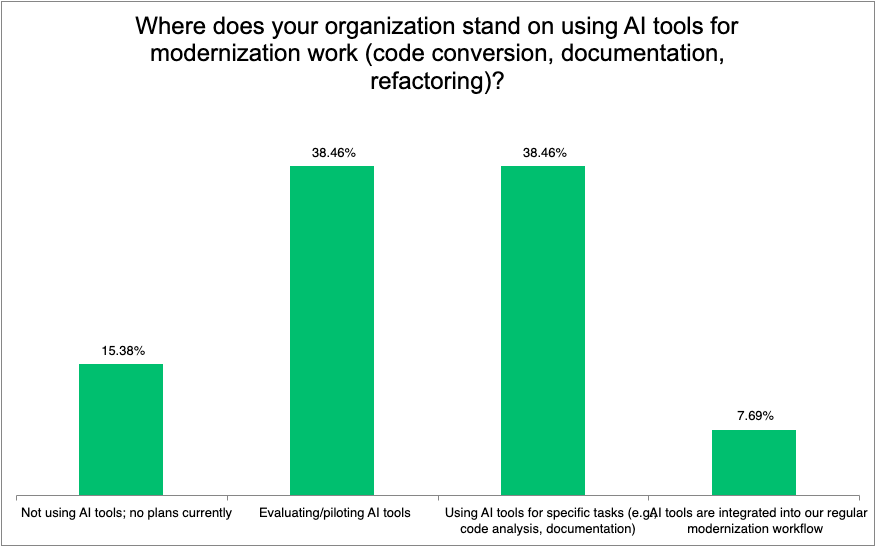
On the use of AI tools for modernization tasks like code conversion, documentation or refactoring, respondents were evenly split between two stages of adoption. Five respondents said they’re evaluating or piloting AI tools while another five said they’re already using AI for specific tasks. Only one respondent reported AI tools are fully integrated into their regular modernization workflow, while two said they weren’t using AI tools and have no current plans to.
No single factor dominates modernization motivation.
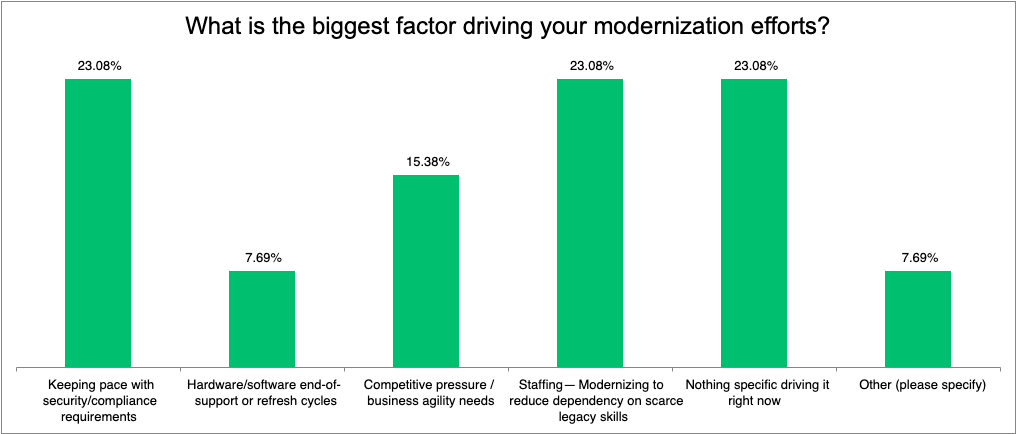
Asked what’s driving their modernization work, respondents spread their answers across the board. Security/compliance requirements, staffing concerns (reducing dependency on scarce legacy skills) and “nothing specific driving it right now” each tied for the top spot (three respondents apiece). The three-way tie—including a notable chunk of respondents citing no clear driver at all—suggests modernization is as much a matter of organizational culture as it is a response to any one pressure.
Legacy IBM i forms remain a hybrid patchwork for most shops.
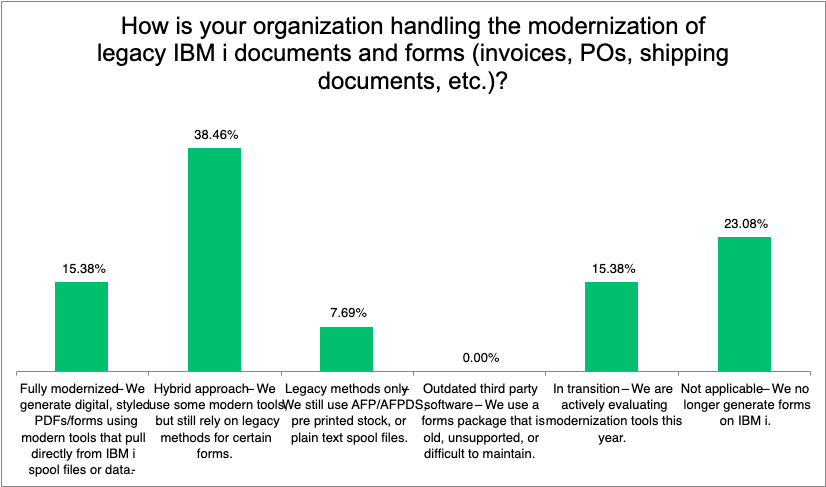
When it comes to modernizing legacy IBM i documents and forms—invoices, POs, shipping documents and the like—five respondents described a hybrid approach, using some modern tools while still relying on legacy methods for certain forms. “Not applicable” (no longer generating forms on IBM i) was the next most common answer, with three selecting that option. Two respondents said they were fully modernized, while another two said they were in-transition on that front. Just one respondent reported still relying on legacy methods only—AFP/AFPDS, pre-printed stock or plain text spool files.
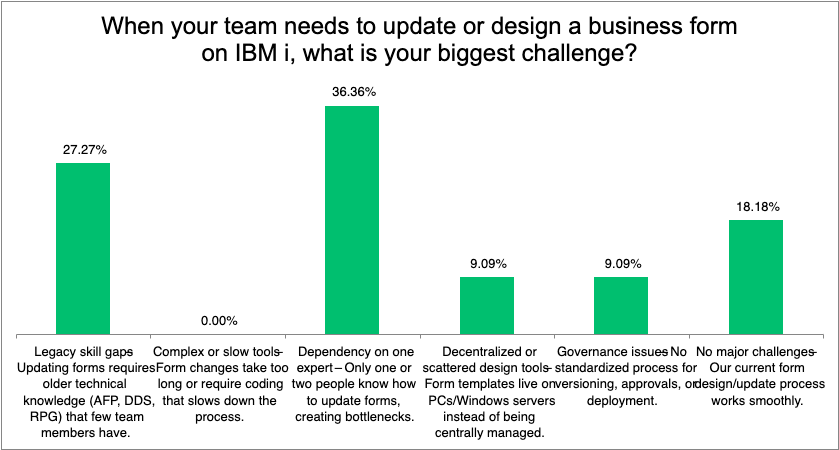
When forms need updating, one expert usually holds the keys.
Among the 11 respondents who answered this question, the single biggest challenge in updating or designing business forms on IBM i was dependency on one expert—cited by four of the technologists, pointing to a bottleneck risk if that person leaves or is unavailable. Legacy skill gaps requiring older technical knowledge (AFP, DDS, RPG) followed, selected by three respondents. Decentralized/scattered design tools and governance issues (no standardized process for versioning, approvals or deployment) were each selected by one respondent. Two reported no major challenges, saying their current process works smoothly.
This report was generated with AI assistance.