Native IBM AIX Security Capabilities: A Cheat Sheet
Ahmed Mashhour, a senior IT managing consultant and IBM Power lead, provides a guide to the security capabilities already built into the OS

In modern enterprise data centers, security, compliance and system integrity are paramount. IBM AIX provides a robust, highly sophisticated suite of built-in security features designed to protect critical workloads without sacrificing performance.
From advanced real-time auditing and fine-grained access control to cryptographic file encryption and network packet filtering, AIX delivers enterprise-grade defense-in-depth capabilities directly within the OS kernel.
Understanding IBM AIX native security capabilities is essential for administrators to effectively protect systems, enforce security policies and meet compliance requirements using built-in features. By leveraging these integrated technologies, organizations can strengthen their security posture, reduce operational risk and maximize the value of their AIX environment.
Auditing and Monitoring Architecture
Security auditing and monitoring form the foundation of proactive threat detection and forensic investigation. IBM AIX provides two powerful, complementary subsystems for this purpose: the AIX Audit Subsystem and the Application Hook and AIX File System (AHAFS).
IBM AIX Audit Subsystem
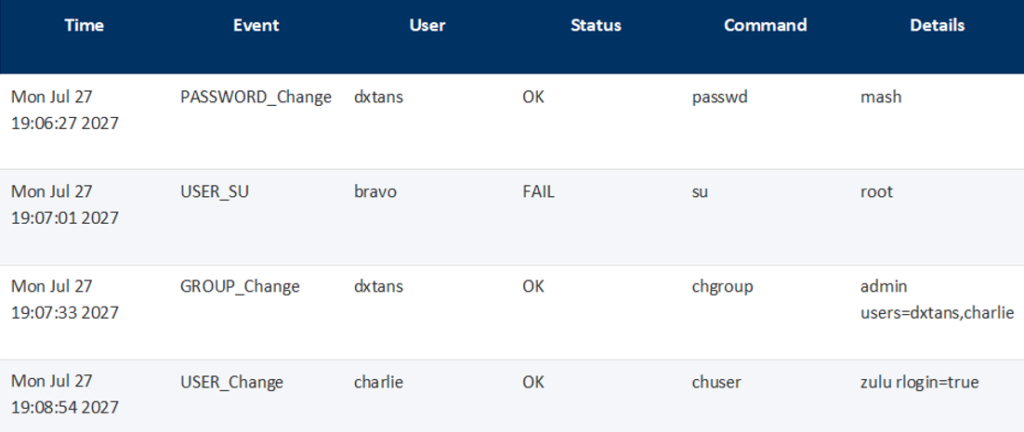
The IBM AIX Audit Subsystem is a built-in security feature that records security-related events and system activities. Unlike standard system logging (such as syslog), the AIX Audit Subsystem focuses exclusively on security auditing by capturing predefined audit events in a structured format. It helps administrators monitor user actions, detect unauthorized access, support forensic investigations and meet strict regulatory compliance requirements.
Core architecture components:
- Kernel audit hooks: Generate audit records directly within the kernel when audited events occur.
- Audit daemon (auditbin): Collects and writes binary audit records to secure trail files (e.g., /audit/auditbin*).
- Audit configuration files: Define which users, security classes and events are actively audited.
- Audit reporting tools: Convert binary audit data into human-readable reports using utilities such as auditpr, auditselect and auditcat.
Key audited security events:
- User login and logout activity, alongside failed authentication attempts
- Password changes and user/group administrative modifications
- File access, file creation, deletion and permission/attribute changes
- Process execution, privileged command execution and administrative actions
- Network-related security events
AHAFS (Application Hook and AIX File System)
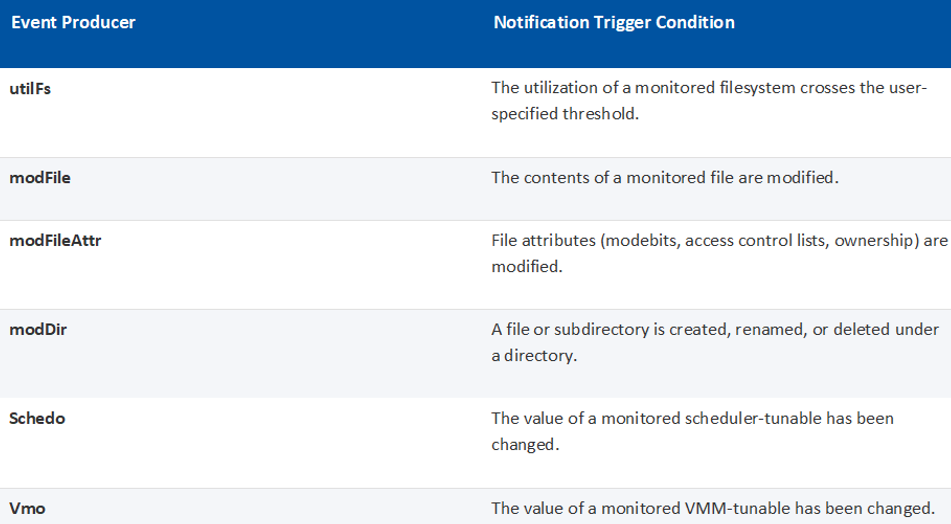
AHAFS is an advanced event notification framework built into IBM AIX that enables applications and scripts to monitor system events in real time. Rather than continuously polling system parameters—which consumes valuable CPU cycles—AHAFS presents system events as a virtual file system mounted under /aha, facilitating highly efficient, event-driven monitoring commonly leveraged for file integrity monitoring (FIM) and systems management.
Access Control Frameworks
Traditional UNIX environments rely heavily on the all-powerful root account, creating significant security risks due to over-privileged users and lack of granular accountability. IBM AIX addresses this through robust role-based access control (RBAC).
Role-Based Access Control (RBAC)
RBAC in AIX restricts access to system resources based on defined roles rather than assigning privileges directly to individual user accounts. It enables organizations to delegate administrative responsibilities according to job functions while rigorously enforcing the principle of least privilege.
Core RBAC Architecture Elements:
- Users: System accounts assigned one or more specific operational roles
- Roles: Logical collections of authorizations and privileges defining administrative scope (e.g., SecurityAdmin, Operator, SysAdmin)
- Authorizations: Permissions controlling access to specific administrative functions and commands
- Privileges: Fine-grained OS capabilities required to perform privileged operations without full root access
- Security databases: Configuration files storing RBAC definitions, user-role assignments and authorization mappings
Key administrative commands for RBAC: Administrators manage RBAC via specialized toolsets including mkrole, lsrole, chrole and rmrole for roles; mkauth, lsauth, Chauth and rmauth for authorizations; and swrole for active role switching.
Permissions Governance and System Integrity
Maintaining predictable permissions and ensuring system binaries remain untampered are critical pillars of an enterprise hardening strategy. AIX achieves this through File Permission Manager (FPM), NFSv4 Access Control Lists (ACLs) and Trusted Execution (TE).
File Permission Manager (FPM)
File Permission Manager (FPM) provides centralized management and enforcement of file and directory permissions across AIX systems. It allows administrators to establish baseline permission policies, monitor managed objects for configuration drift and automatically detect unauthorized permission changes.
NFSv4 Access Control Lists (ACLs)
IBM AIX adopts the NFSv4 ACL model to provide fine-grained permissions and inheritance beyond traditional UNIX owner/group/other mode bits. Crucially in AIX, NFSv4 ACLs are supported on local file systems as well as network mounts. They provide explicit allow/deny entries, detailed user/group access control, and automatic inheritance where child files and directories inherit security settings from parent directories.
Trusted Execution (TE)
Trusted Execution (TE) protects the integrity of critical system binaries, libraries and configuration files by verifying cryptographic signatures and file attributes against a secure baseline stored in the Trusted Signature Database (TSD). TE prevents the execution of modified or unauthorized binaries, offering robust tamper detection and system hardening.
Encryption, Compliance and Network Defense
To safeguard data at rest and protect against network-borne threats, AIX provides native Encrypted File Systems (EFS), automated security hardening via AIXPert, and stateful packet filtering through IPFilter.
[h3] Encrypted File System (EFS)
Encrypted File System (EFS) provides transparent, file-level encryption utilizing strong cryptographic algorithms. Files are encrypted with individual per-file encryption keys managed securely via an integrated Key Management System (KMS). Authorized users access data transparently without requiring application modifications, ensuring protection against physical theft or unauthorized offline media access.
AIXPert Security Hardening
AIXPert is the native AIX security hardening tool that automates the application of predefined or customized security profiles aligned with IBM best practices and regulatory compliance standards. It eliminates manual configuration errors and ensures consistent security baselines across enterprise server deployments.
IPFilter Stateful Firewall
IPFilter is the built-in stateful packet filtering firewall for IBM AIX. It inspects inbound and outbound IPv4/IPv6 traffic, maintains an active connection state table, supports Network Address Translation (NAT) and enforces interface-specific filtering rules to minimize the system’s network attack surface.
Conclusion
IBM AIX delivers a comprehensive, enterprise-grade security architecture built directly into the OS core. By leveraging native capabilities such as the Audit Subsystem, AHAFS real-time monitoring, RBAC, NFSv4 ACLs, TE, EFS, AIXPert and IPFilter, organizations can achieve uncompromising security, rigorous audit compliance, and resilient system integrity across their mission-critical IBM Power infrastructure.