3 Reasons Why Mainframes Are Resurging
For decades, the mainframe was routinely taken for granted as it quietly powered much of the world’s high-transactional data behind the scenes. The prevailing narrative suggested that distributed systems, client-server architectures, and later, the public cloud, would render these powerful machines obsolete. Yet, an undeniable resurgence is now underway. The mainframe, far from fading into obscurity, is proving its enduring value and remarkable adaptability in ways that many previously refused to recognize.
Here is why:
1.MODERN INTEGRATION WITH HYBRID CLOUD
The mainframe’s seamless integration with hybrid cloud environments stands as a cornerstone of its resurgence. Organizations are actively seeking ways to enhance their mainframes by combining them with public and private cloud environments to form new, cohesive computational models. And these systems are no longer merely being maintained; they are actively evolving, and platform use continues to expand among top business performers: Compared to average performing organizations, the absolute best-in-class organizations use an overall IT mix with approximately 10% more public cloud, 10% more mainframe, and 20% less distributed compute power.

2. AI-DRIVEN INSIGHTS, UNMATCHED SECURITY AND RESILIENCY
Mainframes are no longer confined to merely processing transactions; they are rapidly evolving into powerful engines for artificial intelligence (AI) and machine learning (ML). Nearly 80% of companies deem mainframes essential for AI-driven innovation and predictive analytics. Modern mainframes are using AI/ML for real-time fraud detection, enhanced cybersecurity, and more valuable data insights than ever before.
3. TOTAL OR “TRUE” COST OF OWNERSHIP
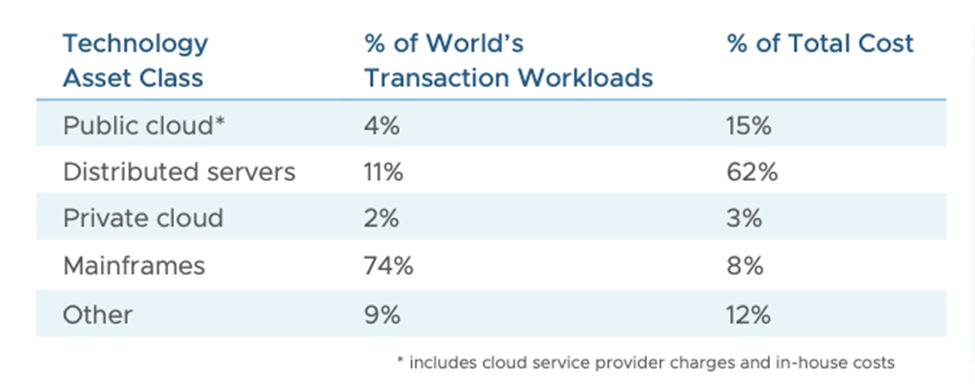
The long-term operational cost advantage of mainframes–especially in areas like software licensing and ongoing maintenance at enterprise scale–is a critical, though often overlooked factor behind their resurgence. Financial analyses show that while initial hardware investments may be slightly higher, the savings in software licensing and maintenance are significant. For example, over a five-year period, software licensing might total $1.8 million for a distributed server farm versus just $0.41 million for a mainframe. For mission-critical workloads, that translates to a consistently superior total cost of ownership. And the efficiency story does not end there. Even with the continued rise of public cloud and distributed servers, mainframes still process up to 74% of the world’s transactional workloads–a 2% increase from last year–while accounting for only 8% of total IT spend. How’s that for an economic advantage?
THE FUTURE IS MAINFRAME
Simply put, the resurgence of the mainframe is a big business reality. It underscores a pragmatic approach to enterprise IT, where the most robust, secure, and scalable platform continues to serve
as the foundation for the world’s most demanding industries, from finance and government to retail and healthcare. Today’s “big iron” is no longer overlooked; it is upheld as an indispensable, evolving, and future-ready powerhouse in our booming digital economy. ■