June TechPulse Recap: HA/DR Confidence More Common Than Full Validation

For June, TechPulse asked IBM Power professionals about the state of their high availability and disaster recovery (HA/DR) environments, surveying 33 IBM Power professionals on the state of their HA/DR posture. The results point to a community that feels reasonably good about its recovery readiness in the abstract, but that confidence confidence softens once the questions turn to testing cadence, validated recovery times and actual data-loss exposure.
Most feel good about their HA/DR solutions, even if they aren’t fully tested.
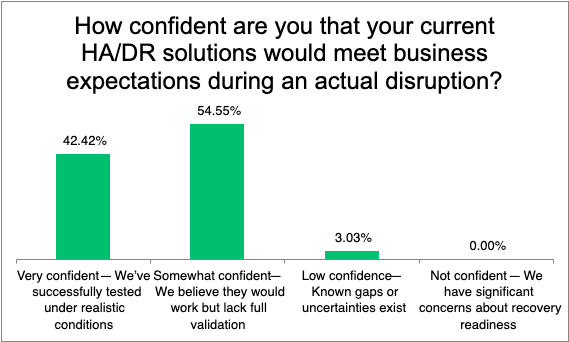
Asked how confident they are that their HA/DR solutions would meet business expectations during an actual disruption, roughly 42% of respondents said they were very confident, having tested their solutions under realistic conditions. But the majority—about 55%—landed on somewhat confident; they believe their setup would work but haven’t fully validated it. A small number reported low confidence due to known gaps or uncertainties.
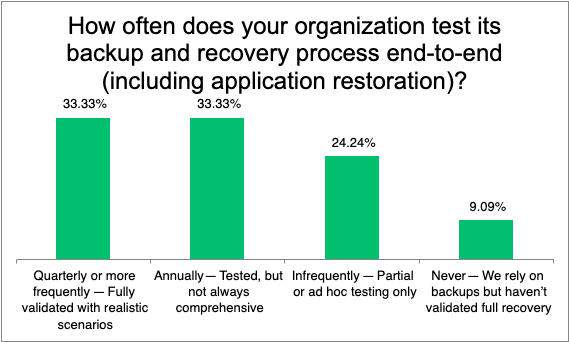
Nearly a third rarely or never test a full recovery.
The survey found organizations’ end-to-end backup and recovery testing evenly split between the two most rigorous options — quarterly and annual testing were tied, each drawing about a third of respondents. Roughly a third test quarterly or more frequently with realistic scenarios, while another third test only annually but not always comprehensively. Of the remainder, about 24% said testing is infrequent or ad hoc, while roughly 9% said they never validate a full recovery, relying on backups alone. Cross-referencing individual responses shows nearly every “very confident” respondent also reported quarterly-or-better testing, while several “somewhat confident” and “low confidence” respondents reported testing only annually or infrequently.
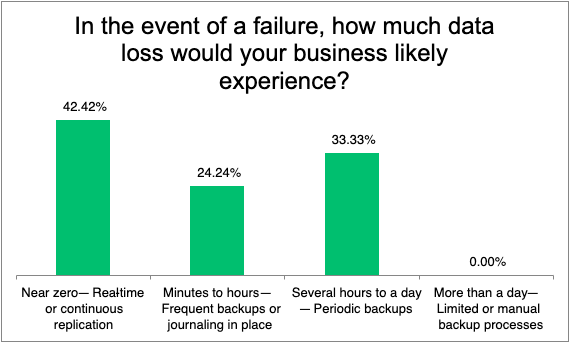
A meaningful chunk of data is still exposed to a full day of loss.
When asked how much data their organization would likely lose in a failure, about 42% said near zero, pointing to real-time or continuous replication. Roughly 24% estimated minutes to hours of loss thanks to frequent backups or journaling, while about a third said they’d be looking at several hours to a day of loss from periodic backups. No respondents reported exposure of more than a full day, but a third of the community is still relying on backup windows wide enough to lose the better part of a business day.
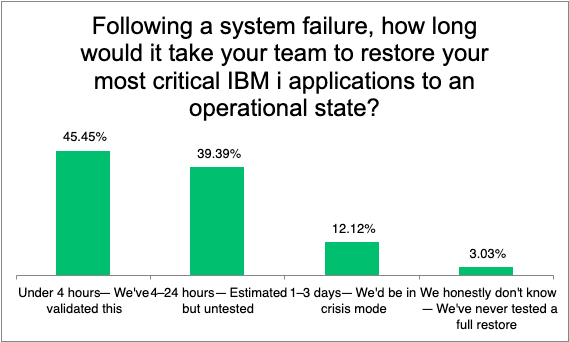
Recovery time estimates lean optimistic.
Asked how long it would take to restore their most critical IBM i applications after a failure, about 45% said under four hours, and said they’ve validated that number. Close behind, roughly 39% put the figure at four to 24 hours but flagged that estimate as untested. Another 12% said they’d be in crisis mode for one to three days, and a small number admitted they don’t know because they’ve never tested a full restore.
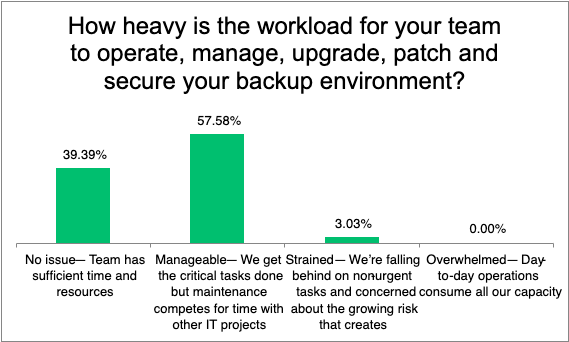
Most teams find their backup workload manageable.
On the operational side, about 58% of respondents described their team’s workload for operating, managing, upgrading, patching and securing the backup environment as manageable—they get the critical tasks done, but maintenance competes with other IT projects for time. Roughly 39% reported no issue, with sufficient time and resources. Only a small number described the workload as strained, and no one reported being fully overwhelmed.
This report was generated with AI assistance.