Why Linux on IBM Z Continues to Grow
Continuing his series, "The IBM Z Experience," Joe Gulla explains how IBM achieves enterprise‑grade open source at mainframe scale, and why the market demands it
Linux on IBM Z occupies a unique position in enterprise computing. Its influence and use has grown over more that 25 years starting with s/390. Linux on Z reflects an important commercial decision by IBM and enterprise customers to bring open-source innovation together with mission‑critical transactional workloads like those running in CICS and IMS. This inventive use of mainframe computers has happened all around the world.
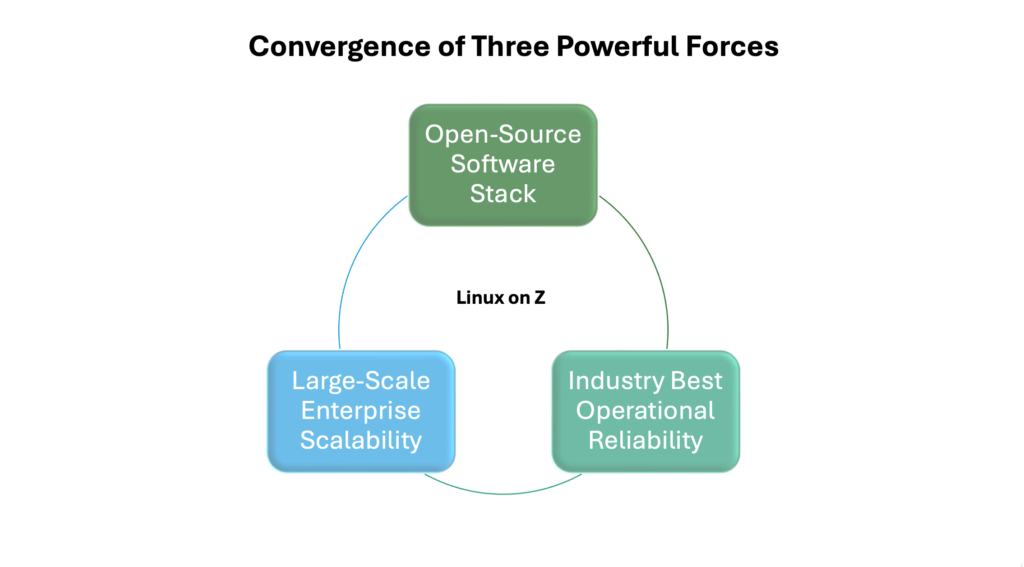
On the surface, Linux on Z looks straightforward. Linux runs on a mainframe like it does on other servers. However, on Z it is the meeting point of three powerful strengths which include an open-source software stack, large-scale enterprise scalability and industry-best operational reliability. This makes for a powerful server consolidation opportunity for Linux-based workloads.
Today, enterprise Linux is widely used and continues to grow, with 96 of the top 100 IBM Z enterprises running Linux on Z as of Q1 2025. Additionally, installed Linux Integrated Facility for Linux (IFL) MIPS are growing at a 21% compound annual growth rate (CAGR). Understanding why Linux on Z thrives, how it scales, where it is being adopted and how it interoperates with z/OS reveals why it remains increasingly important in an era dominated by hybrid and multi‑cloud architectures. The sections that follow explore Linux on Z across five topics:
- Its origins
- Its enterprise‑grade scaling characteristics
- Its adoption trends
- Its deep interoperability with z/OS
- Its foundational role for modern container platforms
1. Its Origins—Why Linux on Z Exists
The introduction of Linux on IBM Z was a deliberate response to shifting enterprise developments. By the late 1990s, enterprises faced a growing challenge as innovation was increasingly happening outside proprietary systems. Open-source software, especially Linux, was rapidly becoming the default platform for web servers, middleware and emerging distributed architectures.
Enterprises wanted to adopt Linux, but they did not want to abandon the security, scalability and operational stability of their mainframe environments. IBM acknowledged that the future was not about replacing z/OS but about locating open systems next to core applications and middleware running under z/OS.
It made sense to work to accommodate open systems on the mainframe, which was supported by ever-expanding CPU capacity and memory growth. MIPS are still used as a standardized measure, but mainframe speeds are now much faster. While individual cores on IBM z17 are highly capable, the true power of the system comes from aggregating more than 200 cores. This results in total processing throughput measured in trillions of instructions per second across parallel workloads.
IBM Created the Integrated Facility for Linux
The key driver for adoption was the Integrated Facility for Linux (IFL). The IFL is a specialty processor designed to run Linux workloads natively on IBM Z without impacting traditional mainframe software pricing. This was an important decision by IBM. By separating Linux workloads from general-purpose central processors, IBM removed the economic barrier that would have made Linux on Z a weak value proposition.
The IFL did more than reduce cost as it created a dedicated execution environment optimized for Linux. This allowed enterprises to scale Linux workloads independently while still benefiting from the mainframe’s architectural strengths.
Table 1. The IBM Z Strengths That Linux Exploits
| Z Resource | Strength of the Z Resource |
| CPU | Up to 208 cores on 26 chips. IBM supports very high ratios of IFLs. All cores can be IFLs or a mix of CPs, IFLs & zIIPs. |
| Memory | Up to 64 TB or 65,536 GB is supported. |
| Bandwidth | Network and clustering connectivity: Extensive external LAN/WAN configurations are supported. |
| I/O throughput | I/O subsystem: Includes support for FICON, OSA and other high-speed interfaces. |
| Hardware reliability | 99.999999% availability: About 0.32 seconds of downtime per year, roughly 315 milliseconds annually. In enterprise terms, especially for IBM Z environments, this level of availability typically assumes: (1) planned maintenance excluded (2) redundant components and (3) continuous operation with failover (not single-instance uptime). |
Enterprise Linux Fits Well Because it Is Native to the Instruction Set
Unlike earlier attempts to host open systems through emulation or off‑platform integration, Linux on Z is native. Linux distributions are compiled specifically for the IBM Z architecture. They exploit 64‑bit addressing, hardware cryptography and virtualization acceleration, as well as high‑performance I/O paths. Since this is not a ported Linux, it is engineered to make use of the mainframe’s architectural strengths. The result is an environment where open-source middleware, tooling and development practices coexist effortlessly with long-standing enterprise workloads.
There are three main enterprise Linux distributions. Red Hat Enterprise Linux (RHEL), SUSE Linux Enterprise Server (SLES), and Ubuntu Long Term Support (LTS). These run on IBM Z and align with enterprise wants and needs like software support, a well-defined lifecycle and integration with the platform. For example, all distributions supply enterprise-grade software support for major open-source stacks including Java (OpenJDK), Python and Node.js. Also, they handle key databases including PostgreSQL, MySQL and MongoDB. Web servers including Apache and NGINX are supported as well. Additionally, these distributions have certified integration with:
- Middleware from IBM including MQ, Db2 and WebSphere/Liberty
- Kubernetes platforms including OpenShift, Rancher and Canonical K8s
These Linux distributions also have maintenance and lifecycle support shown in Table 2.
Table 2. Lifecycle Support for Enterprise Linux Distributions
| Distribution | Duration |
| RHEL | ~10+ years with Extended Lifecycle Support (ELS) |
| SLES | 10+ years plus Long-Term Service Pack Support (LTSS) |
| Ubuntu LTS | Five years standard and up to 10+ with Extended Security Maintenance (ESM) |
The support includes security patches, bug fixes and hardware enablement updates. The products are also optimized for IBM Z, including optimizations for large memory systems, high I/O throughput and SMT and vertical scaling. All three distributions are compiled and tuned specifically for Z hardware.
In addition, all three distributions have virtualization and container integration with full support for z/VM and KVM for IBM Z, Docker/OCI containers and Kubernetes ecosystems. This support allows high-density VM environments and cloud-native workloads on a mainframe. These Linux distributions also offer enterprise support, including certification with vendor-backed offerings and certifications for SAP workloads.
In short, Red Hat, SUSE and Ubuntu on IBM Z combine open-source flexibility and innovation with System Z robustness and availability. But while Red Hat, SUSE and Ubuntu on IBM Z share a common Linux foundation and focus, they differ in philosophy and have many differences in implementation approach and tactics.
2. Its Enterprise-Grade Scaling Characteristics—Scaling Is More Than the Number of CPUs and Their Speed
When engineers discuss scalability, the conversation often narrows to CPU count or clock speed. On IBM Z, scalability is much broader and far more nuanced. Linux on Z inherits decades of mainframe innovation in resource management, I/O architecture and fault tolerance.
Linux on Z systems routinely support hundreds to thousands of Linux instances on a single physical machine. This density is operationally sustainable because of predictable performance characteristics and robust virtualization.
VM Density and Virtualization Leadership
Most Linux on Z environments run under z/VM, which remains one of the most mature hypervisors ever built. z/VM specializes in high-density virtualization, efficient CPU overcommit and intelligent memory sharing. It was designed from the beginning to run thousands of virtual machines with consistent performance.
Table 3. Linux Guests on z/VM Have These Benefits
| Benefits | Why it Matters |
| Extremely low virtualization overhead | Typically, in the ~1–2% range (often described as “near-native performance”). |
| Sophisticated scheduling and workload isolation | z/VM has an advanced CPU scheduler inside its Control Program (CP) that dynamically allocates CPU time, uses shares, weights and priorities while efficiently supporting overcommitment and minimizing idle time. |
| Efficient use of large memory footprints | z/VM efficiently manages large memory footprints through dynamic allocation, memory sharing and optimized paging, enabling thousands of virtual Linux instances to run within a single system without requiring proportional physical memory. |
| Integrated virtual networking at scale | On IBM Z, networking is not an external dependency. z/VM embeds a high-speed virtual network fabric within the system, allowing thousands of Linux workloads to communicate at memory speeds with built-in isolation and scalability. |
This makes Linux on Z uniquely suited for workload consolidation, supporting dozens or hundreds of x86 servers in a single, highly controlled system footprint.
Parallel Sysplex Integration
Although Linux on Z does not participate in Parallel Sysplex the same way z/OS does, it does integrate tightly with Sysplex‑based environments. Linux guests can run physically close to Sysplex members, accessing shared dataset and other files, messaging infrastructure and transactional systems with very low latency. The value here is being close to the digital activity. Instead of introducing latency, enterprises can place Linux-based services directly beside the core systems they depend on.
High Availability and Predictability
Linux on Z inherits the mainframe’s defining characteristic—predictable uptime—so high availability on IBM Z is an important, well-understood feature. Planned outages are rare, as much has been done to support change without bringing systems down. Unplanned outages, for both hardware and software, are rarer.
Hardware-based redundancy, live partition mobility, dynamic resource reallocation and sophisticated error detection allow Linux workloads to remain highly available through maintenance cycles that would require downtime elsewhere. For enterprises running customer-facing digital services, this predictability is highly valued.
On top of the IBM Z base availability features, there are additional logical considerations that arise from the attributes of the Linux-based application that is running. Achieving continuous operations and continuous availability, in addition to high availability, typically takes additional planning and actions.
3. Enterprise Linux Adoption Trends
Linux on Z adoption is best understood as careful positioning. The enterprises that adopt Linux on Z typically do so because they recognize that distributed workloads and core systems are interdependent. Financial services, insurance, government, healthcare and large retailers have been among the earliest and most consistent adopters.
These industries share common characteristics including high transaction volumes, demanding compliance requirements, long application lifecycles and dependence on existing mainframe data and applications. In addition to hardware and software elements, these organizations have significant data, key personnel and detailed IT processes and procedures. Understandably, large enterprises have complex and multi-faceted IT systems.
Fit for Hybrid and Multi‑Cloud Environments
Modern enterprise architecture typically includes hybrid and multi‑cloud systems. Linux on Z fits naturally into this pattern by acting as a key private‑cloud component embedded within the enterprise’s most trusted platform. It has an important role in integrating with the overall environment made up of various systems and applications.
Table 4. Linux on Z Environments Routinely Integrate With Other Tools and Processes
| Tool and Process | Why it Matters |
| Public cloud CI/CD pipelines | CI/CD integration connects the reliability and scale of IBM Z with the velocity of cloud-native development. This allows applications to be built once and easily deployed across cloud and mainframe environments. |
| Git-based development workflows | Git has become the universal language of software development. Integrating Linux on Z with Git workflows ensures that enterprise-grade workloads move forward at the same pace and with the same collaborative discipline as cloud-native applications. |
| Open-source middleware stacks | Open-source middleware is the backbone of modern applications. By embracing it, Linux on Z becomes part of a global ecosystem where applications, data and services flow seamlessly across cloud, distributed and mainframe environments. |
| Infrastructure-as-Code (IaC) tools | Infrastructure‑as‑Code turns infrastructure into software, allowing systems on IBM Z and others to be provisioned, versioned and scaled with the same speed, precision and discipline as other modern applications. |
The difference with enterprise Linux is not in the software but in where that software executes. Instead of pushing sensitive workloads outward and compensating with layers of security, enterprises can pull cloud-native patterns inward, closer to systems of record resident in the mainframe.
Economic and Operational Drivers
Cost efficiency plays a significant role because as enterprises adopt Linux on Z, they reduce server sprawl, data movement costs, network complexity and operational risk. A single Linux on Z system can replace large x86 farms while offering superior resource utilization and dramatically lower administrative overhead.
4. Its Deep Interoperation with z/OS
The real strength of Linux on Z is how seamlessly it interoperates with z/OS. Rather than treating Linux as a peripheral platform, successful architectures treat it as an extension of the mainframe environment.
Messaging and Integration With IBM MQ
IBM MQ remains one of the most important integration technologies in mixed z/OS and Linux environments. Linux on Z applications routinely use MQ as a high‑throughput, reliable bridge into z/OS transaction processing systems. Because MQ can run natively on both platforms and because both can reside on the same physical machine, latency becomes negligible, reliability improves, and operational complexity decreases.
Application Connectivity and Transformation
Application Connect Enterprise (ACE) on z/OS and App Connect on Linux form another common integration pattern. Linux-based microservices can transform, enrich and route data while z/OS systems continue to perform core processing. Instead of rewriting stable business logic often written in COBOL, enterprises expose it, orchestrate it and modernize access paths using microservices. These microservices are program-like and consist of independent services that communicate through lightweight APIs.
APIs and z/OS Connect Enterprise Edition
z/OS Connect Enterprise Edition has been very useful in enabling API‑driven access to z/OS assets like applications and data. Linux on Z complements this software by hosting gateways, microservices and other software layers. Why is Linux hosting these software layers?
Table 5. Why These Layers, Gateways and Such Are Important
| Layers | Why They Are Important |
| API gateways | An API gateway acts as the single entry point for all external requests. |
| Microservices | Modular application components that function like programs with logic and interfaces to applications and data without changing the applications of record. |
| Authentication and mediation layers | Focus is security, governance and integration. |
API gateways, microservices and authentication/mediation layers are important because they form the core architectural pattern of modern, distributed, API‑driven systems. Together, they enable applications to be modular, scalable, secure and interoperable. Employing this pattern is especially important in hybrid environments with Linux on Z.
Developers can work in familiar Linux environments while securely accessing core application functionality through standardized APIs. Linux on Z often becomes the front door consisting of new ways to access existing functionality. While Linux on Z might function as the frontend, z/OS remains the system of authority.
API Management and Security using API Connect and DataPower
IBM API Connect and DataPower frequently run on Linux on Z to provide enterprise‑grade API governance, security and traffic mediation. This architecture approach places API management close to the systems it protects, reducing security exposures (fewer attack surfaces) and simplifying network design. API governance is like traditional application management. Think of APIs as programs, and you will quickly realize the potential consequences of poor version control of APIs.
5. Linux on Z’s Foundational Role for Modern Container Platforms
Containerization emerged to standardize application deployment. Linux on Z provides one of the most stable and secure environments for container platforms, precisely because it already excels at isolation, density and lifecycle management.
Kubernetes on IBM Z
Modern Linux on Z environments commonly run Kubernetes (including OpenShift). These platforms bring:
- Strong application lifecycle management
- Standardized deployment pipelines
- Horizontal scaling patterns
- Integration with enterprise CI/CD
Running on IBM Z, what changes is not Kubernetes (as it behaves the same as anywhere else) but the durability of the platform beneath it.
Why Containers Belong Close to Data
For enterprises with large z/OS environments, containers running on Linux on Z eliminate unnecessary distance between new applications and mission‑critical data. Instead of compensating with caching layers or new replication strategies, architects can design solutions that are direct, synchronous and as reliable as they are on an IBM Z.
Additional Thoughts on Enterprise Linux
In some ways, Linux on Z is a bridge. It connects decades of enterprise computing experience to newer, cloud‑native operational models. Container platforms amplify the value of Linux on Z. They allow enterprises to modernize at the pace they choose, without abandoning the systems that built their business. Linux on IBM Z exists because enterprises needed a way to embrace open-source innovation without sacrificing the qualities that make mainframes indispensable. Over time, it has proved not only viable, but strategically important.
By combining open ecosystems with unmatched scalability, reliability and proximity to core systems, Linux on Z enables architectures that are extremely difficult to replicate elsewhere. This is summarized in the additional details in Figure 2, below.
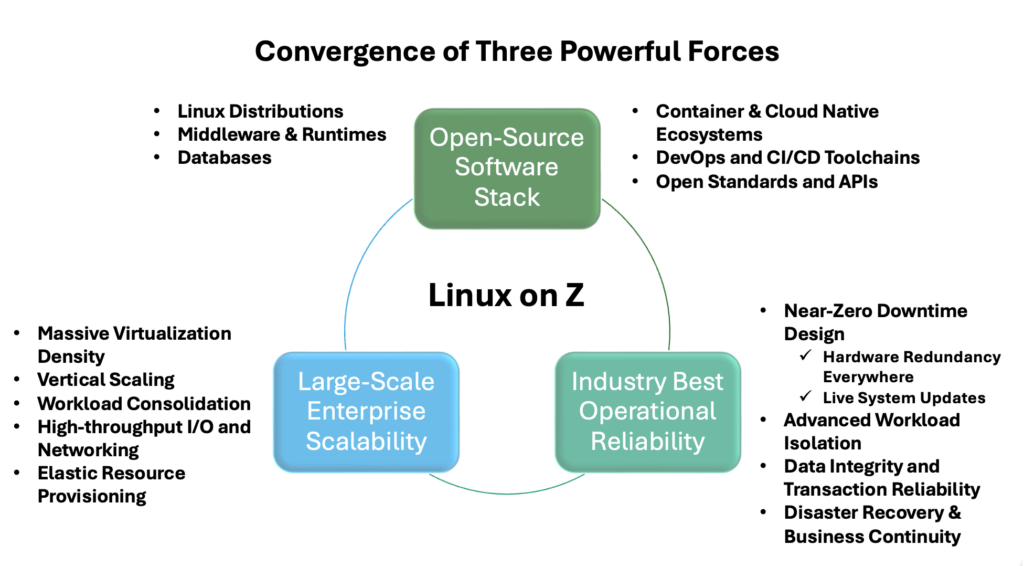
Figure 2. Linux on System Z—details behind the three forces.
As enterprises continue their hybrid and multi‑cloud journeys, Linux on Z remains a powerful reminder that modernization does not require displacement. It requires integration, evolution and architectural intent.
In the next article, I will examine how containerization builds directly on this foundation, and why Kubernetes on IBM Z is less a novelty and more a highly valuable strategy with many meaningful rewards.