October TechPulse Recap: Governance
October’s IBM Power TechPulse survey covers governance challenges, the impact on new initiatives, AI oversight and forms and label controls

For October, TechPulse asked IBM Power professionals about governance: what makes security and governance requirements hard to apply, whether those requirements slow new initiatives, how AI applications are governed and what’s hardest about governing IBM i forms and labels. Eight respondents weighed in. Due to the limited sample size, results are best read as directional.
Integration, Cross-Platform Visibility and Resources Tie as the Top Governance Challenge
Three challenges tied for the top spot, each cited by two of eight respondents: integrating systems and applications with organization-wide security and governance processes, maintaining visibility and consistent controls across IBM i, AIX, Linux and other environments, and limited staff time, expertise or budget. Legacy applications that can’t easily meet current requirements and keeping up with changing regulatory, audit or AI-related requirements were each named by one respondent. No one said they face no significant challenge.
Together, the three leading answers account for six of eight responses, and two of them are about fitting Power into the wider governance picture rather than meeting any single rule.

Governance Requirements Mostly Haven’t Slowed New Initiatives
Half of respondents (four of eight) say governance, security and compliance requirements haven’t noticeably affected the pace of new technology initiatives over the past 12 months. One said requirements added review time but initiatives proceeded, and one said requirements significantly delayed one or more initiatives. Two respondents have no new technology initiatives involving Power systems.
No one reported scaling back or canceling an initiative because of requirements, or pausing one because of insufficient governance or controls. Setting aside the two respondents with no new initiatives, four of six say requirements haven’t changed their pace.

AI Governance Mostly Runs Through Existing Policies
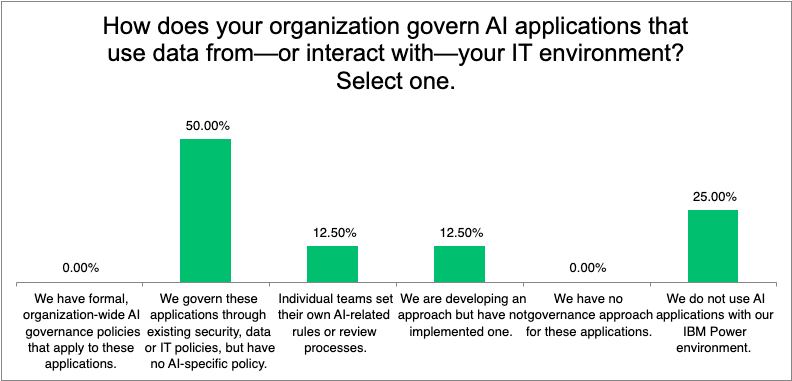
Four of eight respondents govern AI applications that use data from or interact with their IT environment through existing security, data or IT policies, without an AI-specific policy. One said individual teams set their own AI-related rules or review processes, and one is developing an approach but hasn’t implemented one. Two don’t use AI applications with their IBM Power environment.
No one reported formal, organization-wide AI governance policies, and no one said they have no governance approach at all. Among the six respondents using AI with Power, four rely on general policies, which suggests AI oversight is being folded into existing frameworks rather than built separately.
Tracking Changes and Versions Is the Hardest Part of Forms and Labels Governance
Half of respondents (four of eight) named tracking changes and versions as the most challenging aspect of governing forms and labels. Two cited meeting compliance requirements. Documenting approvals and audits and managing templates across locations were each selected by one respondent. No one chose controlling who can make changes.

Version Control Tops the Forms and Labels Wish List
Version control and history was the capability most respondents (three of eight) said would improve governance of forms and labels. Role-based access controls and a centralized template repository were each chosen by two, and one picked electronic approvals and workflows. No one selected audit reporting.
This lines up with the previous question: tracking changes and versions was the biggest pain point, and version control is the most-requested fix. One wrinkle is that two respondents want role-based access controls even though no one named controlling who can make changes as a top challenge.

This report was generated with AI assistance.