September TechPulse Recap: Performance and Capacity Planning

Performance and capacity planning were the focus of this month’s TechPulse survey of IBM Power professionals. Respondents weighed in on where bottlenecks originate, how long they keep performance history, how well their IBM i environments are optimized and how high-volume document and label generation affects their systems. Due to the limited sample size, results are best read as directional.
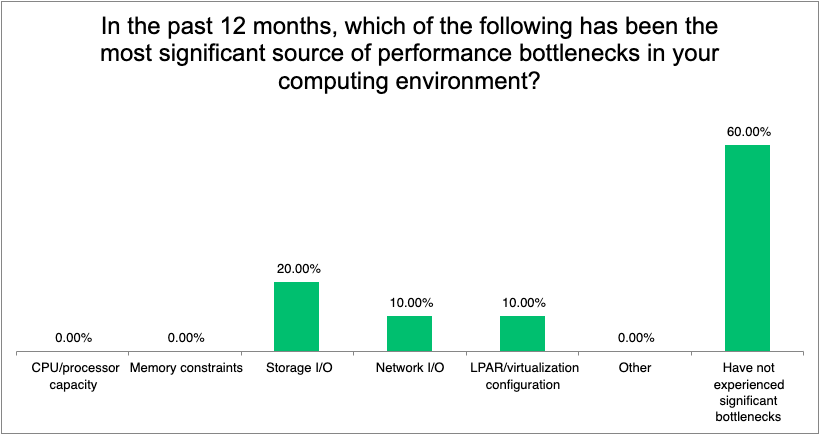
Most Respondents Report No Significant Bottlenecks
Six of the 10 respondents say they haven’t experienced a significant performance bottleneck in the past 12 months. Among those who have, storage I/O was the most common source, cited by two respondents. Network I/O and LPAR/virtualization configuration were each named by one respondent. No one identified CPU/processor capacity or memory constraints as their most significant bottleneck.
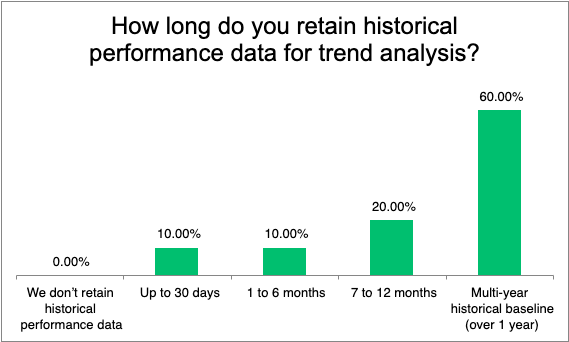
Long-Term Performance History Is the Norm
Six of 10 respondents keep a multi-year historical baseline of performance data. Two more retain data for seven to 12 months, one keeps data one to 6 months and one keeps it up to 30 days. None said they retain no historical performance data, which means eight of 10 keep at least seven months of history for trend analysis.
Most IBM i Environments Are Adequately Optimized, but Some Can’t Say
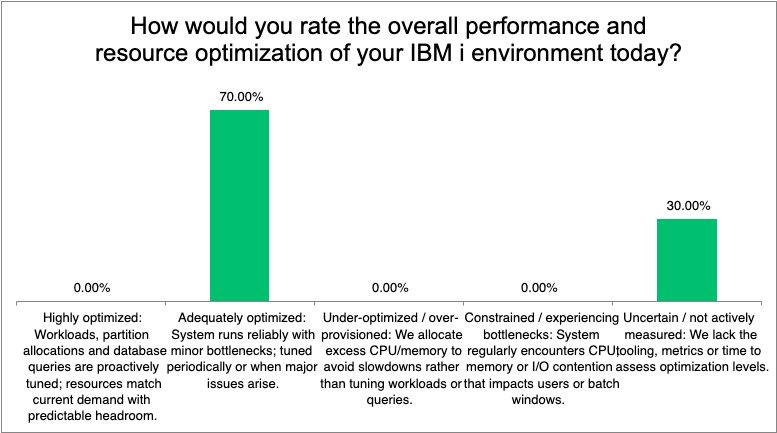
Seven of 10 rate their IBM i environment as adequately optimized; the other three are uncertain. The seven describe systems that run reliably with minor bottlenecks and are tuned periodically or when major issues arise. The other three said they lack the tooling, metrics or time to assess optimization levels. No one rated their environment as highly optimized, under-optimized/over-provisioned or constrained.
This pairs with the retention results above. Six respondents keep a multi-year baseline, yet three still can’t say how well their environment is optimized, a reminder that collecting data and acting on it aren’t the same thing.
Peak Document and Label Generation Causes Noticeable Slowdowns
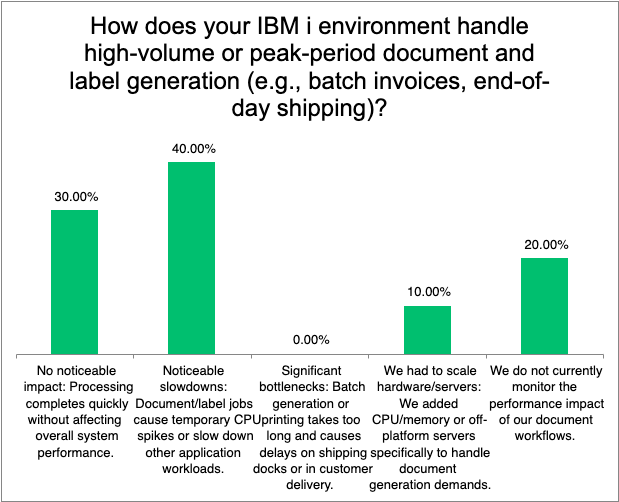
Four of 10 report noticeable slowdowns when generating documents and labels at peak volume. Those four described temporary CPU spikes or drag on other application workloads. Three saw no noticeable impact. One respondent had to scale hardware or add off-platform servers specifically to handle document generation, and two don’t monitor the performance impact of their document workflows. No one reported significant bottlenecks that delayed shipping docks or customer delivery.
Taken together, five of 10 respondents either absorbed slowdowns or added capacity because of document workloads, even though six of 10 reported no significant bottlenecks environment-wide. Document and label generation may be a pressure point that general performance measures miss.
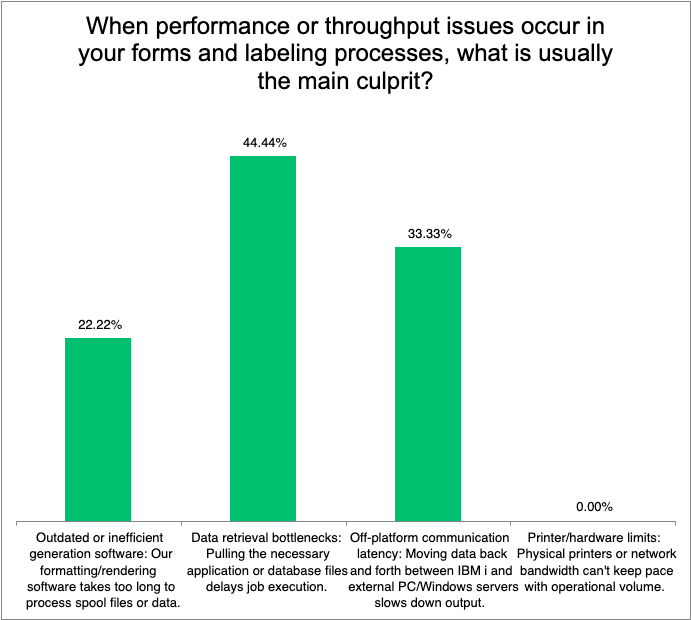
Data Retrieval and Off-Platform Latency Are the Main Culprits
Data retrieval is the top cause of forms and labeling slowdowns, followed by off-platform communication latency. Among the nine respondents who answered, four pointed to data retrieval bottlenecks where pulling application or database files delays job execution. Three named off-platform communication latency from moving data between IBM i and external PC or Windows servers. Two said outdated or inefficient generation software was the main culprit, and no one blamed printer or hardware limits.
Combined, data retrieval and off-platform latency account for seven of the nine responses, pointing to how data moves to and from the document process more than to the printers or the output hardware.
This report was generated with AI assistance.