Manage z/OS Storage Without the Green Screen: A Unified Approach with UDM

From Technical Debt to Storage Mastery: Modernizing z/OS Management with UDM
In the modern agile enterprise, Storage Resource Management (SRM) serves as the cornerstone of operational resilience. However, many organizations remain shackled to “monolithic legacy debt”, rigid architectures that have failed to evolve alongside the data center. When an infrastructure tool requires more effort to maintain than it provides in value, it ceases to be an asset and becomes a strategic liability.
Dino Software’s Universal Data Manager (UDM) is engineered to break this cycle, transforming SRM from a cumbersome maintenance burden into a high-performance strategic asset
The Implementation Revolution: Deploying at Speed
In Enterprise Solutions Architecture, the primary “gatekeeper” of value is the ease of installation. Traditional SRM implementation is often a bloated project requiring extensive network re-engineering that inflates Total Cost of Ownership (TCO) before the first report is even generated
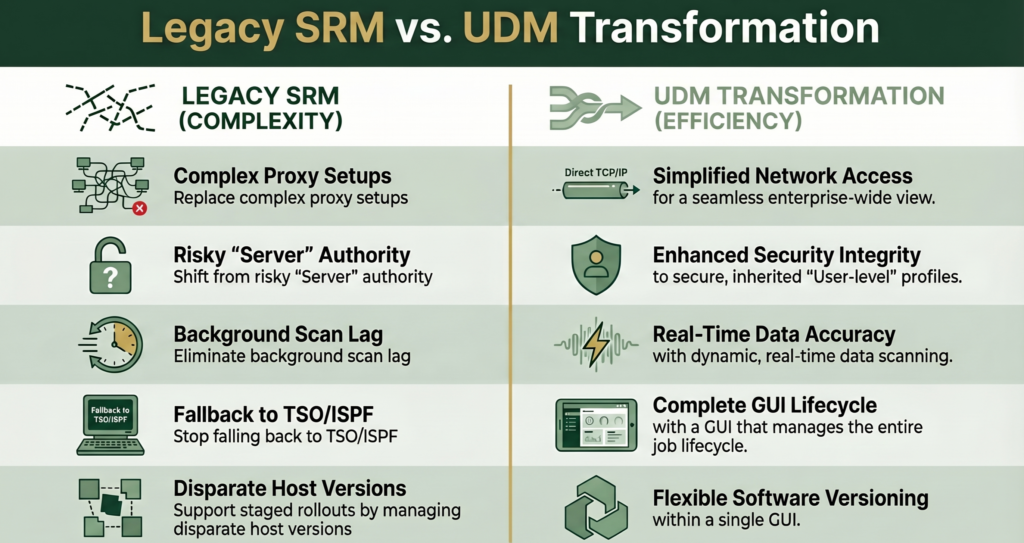
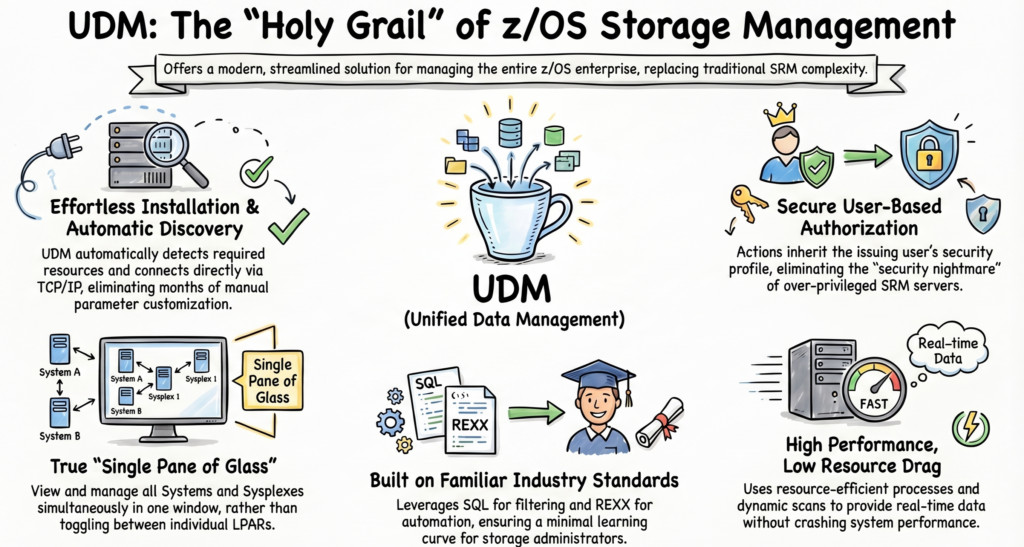
UDM revolutionizes this phase by abandoning restrictive, fragmented proxy-server models. Instead, it utilizes direct TCP/IP access from the GUI to each host system, providing a true “Enterprise view”. This architectural shift offers:
- Rapid Time-to-Value: Automated detection and simplified network configuration paths ensure the tool is operational and secure in a fraction of the time required by legacy competitors.
- Automatic Resource Detection: UDM identifies its environment—such as active CA1 Tape Catalogs, DFSMShsm Control datasets etc—without requiring manual startup parameters on every LPAR.
- Dynamic Adaptation: As the environment changes, UDM adapts automatically, eliminating the need for constant manual updates to SRM configurations.
Five Pillars of Superior Architecture
The strategic value of an SRM tool is measured by its ROI and its ability to reduce Mean Time to Resolution (MTTR). UDM addresses the systemic failures of legacy tools through five key pillars:
1. Ironclad Security Integrity
Legacy tools often create a “security nightmare” by issuing commands under the authority of the SRM server itself. This forces teams to grant excessive privileges to the server, creating a bypass risk. UDM restores integrity by inheriting the authorization profile of the issuing user. For automation, processes inherit the defining user’s authority, ensuring the existing security framework remains the ultimate authority
2. True Enterprise-Wide Oversight
Fragmentation drives operational inefficiency. While legacy offerings force administrators to work at a “system-by-system” level, UDM provides a unified solution. A single request can aggregate data from multiple systems and Sysplexes into one window, eliminating “swivel-chair” management and providing a singular point of truth
3. Strategic Intelligence via Standards
Proprietary scripting and filtering languages are a significant source of technical debt, requiring specialized training and risking obsolescence. UDM utilizes industry-standard SQL filtering and REXX-based automation, reducing the learning curve and ensuring long-term compatibility
4. Real-Time Operational Accuracy
Traditional SRM tools rely on resource-heavy background scans that create point-in-time databases. These snapshots are often aged and irrelevant by the time a query is performed. UDM offers resource-efficient “dynamic scans,” ensuring that critical tasks like catalog cleanup are based on real-time environmental status, while also providing the ability to work with snapshor or history databases
5. Seamless Process Portability
Scaling an enterprise should not involve redundant manual effort. UDM’s “offload/reload” capability for reports, JCL, and automation definitions ensures that existing mastery can be ported anywhere in the enterprise , or to other enterprises, via a simple administrative action. This prevents the duplication of labor and ensures process consistency
Reclaim Your Enterprise
The choice between a legacy tool and UDM is a choice between maintaining technical debt and achieving operational mastery. If your current toolkit forces users back to the “green screen” because its GUI is incomplete or sluggish, it is a detriment to your efficiency.
UDM provides a comprehensive experience that enables administrators to initiate, monitor, and review jobs entirely within a modern interface. It is time to transition to an asset that drives productivity and eliminates the archaic limitations of the past.