Enhancing z/OS Applications While Preserving Core System Integrity: The Technologies You Need to Know
In this edition of the 'IBM Z Experience,' Joe Gulla explains how the mainframe can be so much more than the system of record

Modernization is a word that is used frequently in IT, but less frequently is it defined. So what does it mean?
You probably noticed the answer to that question can be wide-ranging, from enhancing existing systems and applications to a complete replacement of existing hardware and software. Yep, the spectrum of modernization is broad, from fix-it-up to rip-and-replace, with a lot of possibilities in between. I prefer using the term innovation when writing about generating change in IT.
This article explores how enterprises can enhance existing systems and applications on z/OS to innovate while preserving the integrity of their core systems. Doing this with applications native to z/OS is about exposing, extending and integrating existing systems into a broader, hybrid architecture using APIs, microservices and cloud-native integration.
These building blocks are not isolated initiatives, but rather the meat and potatoes of this implementation approach. To use the language of this kind of initiative, the focus is turning the mainframe from a system of record into a supporting player with systems of engagement through important enhancement to existing capabilities. That is the mantra.
Let’s spend a minute on some other definitions:
Table 1. Three Key Terms Used and Their Definitions
| APIs | An application programming interface (API) is a set of rules or protocols that enables software applications to communicate with each other to exchange data and to utilize existing functionality. |
| Microservices | A microservice, or a microservices architecture, is a cloud native architectural approach in which a single application is composed of several loosely coupled and independently deployable smaller components or services. The adverb “loosely” implies that the microservice could be used in different ways or by different application users. |
| Cloud-Native Integration | Cloud-native refers less to where an application resides and more to how it is built and deployed. A cloud-native application consists of discrete, reusable components known as microservices, designed to integrate into any cloud environment. |
Risk Is a Consideration With Innovation
The purpose of innovation strategies should be achieving the goal to expand access, making the applications and their data more useful while avoiding unnecessary disruption. It is important to recognize that decades of embedded business logic, particularly in COBOL-based applications, represent a competitive advantage, not a burden or liability.
Lower-Risk Approaches—Encapsulation and Refactoring
z/OS innovation is best understood as a spectrum of approaches.
Encapsulation is focused onexposing existing functionality via APIs. “Exposing” is the jargon used by the API community ignoring the negative implication of the word. Exposing, in the API context, means “making available”.
Refactoring is another innovation tactic. It is about Improving internal structure without changing behavior. This approach is used when the application of record is a monolith that is hard to maintain and change. The idea is that if you break it up into smaller components, then you can maintain it more easily. Of course, breaking it up creates risk that it will be less stable, or worse, have no impact regarding the intended purpose.
Replatforming and Replacement—Worth the Risk?
Replatforming—for example, moving workloads to Linux on Z or container platforms—is a possible innovation. The potential of taking that approach implies an intimate knowledge of the application being moved from here to there. Replacement—that is, rewriting applications—is typically high-risk and rarely justified. Replacement can also be achieved by substituting a commercial software application for one that was written in-house.
The most effective strategies begin with encapsulation by making existing programs and data accessible without altering their main logic. Compelling idea, right? This helps organizations innovate rapidly at the edge while maintaining stability at the core.
There are a broad range of drivers of innovation. Many lists highlight the demand for real-time data and services, expansion of digital channels like mobile and web, as well as support for hybrid and multi-cloud adoption. These are areas that APIs can make a difference in support of innovation that matters.
API Enablement Is the Foundation
Today’s APIs are a recent invention that in many minds have replaced the former meaning of API. In the past, the industry indicated that reading and writing data via access methods used an API consisting of Open, Read, Write and Close statements. That was the API to access the data which retains meaning and use.
More recently, when people use the term API, they typically mean REST API, first defined in the year 2000 by Fielding. REST APIs provide a lightweight way to build web APIs and are commonly used to enable data exchange between applications, web services and databases. REST APIs are also used to connect components in microservices architectures.
Why Do APIs Come First?
APIs are the cornerstone of modern enterprise architecture. They provide a standardized way to expose business functionality and data, enabling rapid integration with new applications, partners and platforms.
For z/OS environments, APIs serve a critical role as they decouple front-end innovation from back-end systems. This means developers can build up-to-date experiences like mobile applications, web portals and digital services without modifying core transaction systems. This separation dramatically reduces risk and accelerates time-to-market.
What Are the Key Technologies on z/OS
IBM provides a robust API enablement stack for z/OS supporting building, managing and securing APIs. Those products are listed in Table 2.
Table 2. Products to Build, Manage and Secure APIs
| Product | Use | Learn More |
| z/OS Connect Enterprise Edition | Enables RESTful API access to CICS, IMS and Db2 resources. | Create truly RESTful APIs to and from your IBM Z mainframe and getting- started checklists. |
| IBM API Connect | Provides API lifecycle management, governance and developer portals. | Browse educational resources, documentation and community content for IBM API Connect. |
| DataPower Gateway | Acts as a secure, high-performance gateway for API traffic. | An industry-leading, high-security application gateway for modern, traditional and hybrid cloud workloads. |
What Standards?
On IBM System Z, OpenAPI standards primarily use the OpenAPI Specification (OAS) version 3.0 via IBM z/OS Connect. These specifications define RESTful HTTP APIs that let cloud and mobile applications securely access core mainframe subsystems like CICS, IMS, Db2 and MQ without altering back-end code.
What Is the Driver to Use APIs?
Motivations for using APIs include exposing core banking transactions for mobile applications, enabling real-time insurance policy updates, supporting e-commerce order processing and providing partner access to enterprise services. In each case, the API layer acts as a bridge between stable back-end systems and rapidly evolving front-end demands.
What About Governance and Security?
API proliferation without governance quickly becomes a liability. It’s a bad idea not to embrace overall management of APIs like other IT resources. A few examples of effective API management strategies are summarized in Table 3.
Table 3. Management Strategies for Handling APIs
| Strategy | Meaning | Example of Importance |
| Lifecycle management | Managing an API from design and development through deployment, monitoring, updates and eventual retirement. | Ensures APIs remain available and supported throughout their useful life. |
| Version control and backward compatibility | Tracking API changes through versions (such as version1, version2) while minimizing disruption to existing users. | Prevents breaking existing microservices-based applications when changes are introduced. |
| Rate limiting and throttling | Controlling how many requests an API client can make within a specific period. | Ensures fair use among multiple consumers. |
| Identity and access management | Verifies who the user or application is. | Prevents unauthorized access to sensitive data and services. |
Security is especially critical with APIs because there are layers of interaction within the way work gets done. z/OS environments already provide robust identity and access management, so APIs must extend this posture and not weaken it.
What Is a Microservice on a Mainframe?
Microservices are often associated with cloud-native architectures, but their principles apply equally to mainframe environments. The key is to avoid the misconception that everything must be decomposed into microservices. Instead, organizations should apply microservices selectively, focusing on areas where agility and scalability provide the greatest benefit. Domain-driven design can help identify logical service boundaries within existing systems.
Approaches to Microservices on IBM Z
There are several viable strategies on Z. For example, Service wrapping is where existing transactions are exposed as discrete services via APIs.
Another approach is modular refactoring, in which large monolithic programs are gradually decomposed into smaller reusable components.
A third approach is hybrid deployment, where new microservices are developed on Linux on Z or external cloud platforms. Each approach allows incremental progress without disrupting critical workloads.
Enabling Technologies
Modern microservices on IBM Z rely on technologies including Red Hat OpenShift on IBM Z and LinuxONE, containerization using Docker and Kubernetes, as well as Service Mesh technologies like Istio and Linkerd. These enable consistent deployment, scaling and management of microservices across environments. Table 4 summarizes how the technologies help.
Table 4. Technologies That Help APIs Succeed
| Technology | How it Helps |
| Red Hat OpenShift on IBM Z | OpenShift on IBM Z serves as a powerful enabler for microservices by bridging cloud-native agility with the impressive scale, security and low-latency performance of mainframe infrastructure. |
| Containerization using Docker and Kubernetes | Docker and Kubernetes act as the fundamental execution engine and operational blueprint that make microservices practical to build, deploy and scale. |
| Service Mesh technologies like Istio and Linkerd | Service mesh technologies like Istio and Linkerd enable microservices by moving network tasks out of your application code and into a dedicated infrastructure layer. They handle critical jobs like secure service-to-service communication and traffic routing without requiring code changes. |
Hybrid Service Models
In practice, enterprises operate hybrid ecosystems. Typically, you find that z/OS hosts core transaction services while Linux on Z runs containerized workloads. Public cloud platforms host digital applications and are often considered systems of engagement. Microservices act as the connective tissue between these environments, enabling seamless interaction.
Integration With Cloud-Native Applications
The hybrid cloud reality is that few enterprises operate in a single environment. Instead, they span on-premises z/OS systems, private cloud infrastructure and public cloud platforms such as Amazon Web Services, Microsoft Azure and Google Cloud Platform. This hybrid model is here to stay. Most enterprises consider it the new normal.
Integration Patterns
Successful integration strategies rely on multiple patterns including API-driven integration, event-driven architecture and message-based integration. Why are these integration strategies successful?
Table 5. Key Integration Patterns
| Pattern | Why Successful? |
| API-driven integration | RESTful APIs provide synchronous access to services. |
| Event-driven architecture (EDA) | Systems react to events in real time, enabling loosely coupled interactions. |
| Messaging-based integration | Middleware ensures reliable communication between systems. |
Each pattern serves a different purpose and many enterprises use a combination.
Key Tools and Middleware Supporting the Patterns
Integration on z/OS is supported by established technologies. IBM MQ is used for reliable messaging and Kafka for event streaming. z/OS Connect EE is used for protocol bridging and IBM App Connect Enterprise (ACE) is important for orchestration and transformation. These tools allow z/OS to participate fully in cloud-native ecosystems.
Data Integration Challenges
Data is often the most complex aspect of innovation. Maintaining consistency across distributed systems is a big challenge, as is managing latency for real-time interactions and balancing data replication and virtualization. Careful architectural decisions are required to avoid performance bottlenecks and data integrity issues.
DevOps and CI/CD for z/OS Innovation
Innovation is not just about architecture, as it also requires a cultural shift. DevOps practices enable faster and more reliable delivery of applications and services. Historically, mainframe development has been slower and more controlled, but this is rapidly changing for the better. Some key practices and their impact are shown below.
Table 6. The Impact of DevOps
| DevOps Practice | Impact |
| Git-based source control | Git, the de facto industry standard source code manager for the open-source community, is growing in popularity among major organizations, as it is a central part of the modern developer’s toolkit. |
| Automated pipelines using Jenkins or Tekton | Automated pipelines using Jenkins or Tekton speed up software delivery by building, testing and deploying code automatically. |
| IBM Developer for z/OS (IDz) | IDz helps deliver more, faster, with better quality and greater agility. IBM Developer for z/OS was formerly Rational Developer for z Systems (RDz). |
| Zowe CLI and APIs | Zowe CLI integrated with APIs (via the Zowe API Mediation Layer) bridges traditional IBM z/OS mainframes with modern developer workflows. |
Automated testing is particularly important. Unit, integration and regression testing ensure that changes do not disrupt critical systems. Continuous delivery extends to APIs and microservices, enabling frequent updates without downtime.
Security and Compliance in a Hybrid World
Security has always been a strength of z/OS and innovation must preserve this advantage. Core capabilities include RACF (IBM Security Server) for identity and access management, as well as end-to-end encryption and comprehensive auditing and logging. As systems and applications integrate with cloud-native environments, identity and security models must extend beyond the mainframe.
API security is a critical concern, requiring token-based authentication, secure gateways and threat detection and monitoring. Compliance requirements are also a factor. This is particularly important in regulated industries. Modern architectures must ensure that data protection, auditability and regulatory compliance are maintained across all environments.
Avoid Pitfalls Through a Fitting Roadmap
Efforts to innovate often encounter challenges. Some teams overreach and attempt to transform too much at once. Starting small and growing is better. Some teams forget the lessons of the past and don’t focus on API governance, which can lead to fragmentation and duplication.
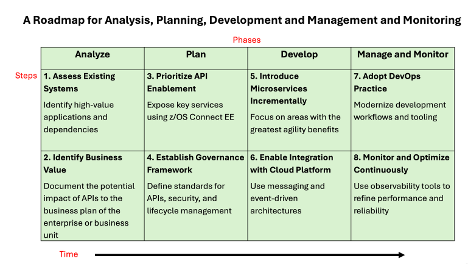
Design is important, so flaws like creating overly granular or tightly coupled services need to be avoided. A structured approach increases the likelihood of success. Figure 1 provides some basic but useful guidance.
Getting it Right—Moving Forward
Getting expert help, sometimes from outsiders, can get things off to a better start. Building a diverse team is key so you can bridge mainframe and cloud-native expertise. There can be operational challenges and performance issues. Managing distributed systems is tough without proper tooling. Latency issues can arise from excessive abstraction, impacting performance. Successful organizations adopt a pragmatic approach, focusing on incremental value rather than sweeping change.
Likely, the most important principle in an API project is alignment with business outcomes. Technology decisions must be driven by measurable value. It is important to focus on three main strategic considerations:
1. APIs provide the gateway to innovation, enabling core systems to interact seamlessly with modern applications.
2. Microservices introduce agility and scalability, allowing enterprises to evolve incrementally.
3. Cloud-native integration connects these capabilities into a cohesive, hybrid ecosystem.
For organizations willing to embrace this approach, the result is a sustainable platform for continuous innovation. You can achieve an outcome that preserves the strengths of the mainframe while fully participating in the digital economy.
Next Article in the Series
In the next article in this series, I will use an end-to-end example to illustrate what it is like to develop a microservice with APIs. The example will use the IBM API software designed for use with applications running under z/OS. I’ll explain this, step by step, using a straightforward example.