November TechPulse Recap: AI Coding Tools Are in the Door, but Not Yet in the Workflow

For November, TechPulse asked IBM Power professionals about application development—how much AI coding tools factor in, how source code is managed, what’s slowing delivery, where new development is happening and how forms and labels get built. Twenty-three respondents weighed in, and the results suggest a community that’s experimenting with AI while still leaning on long-standing practices for source control and forms.
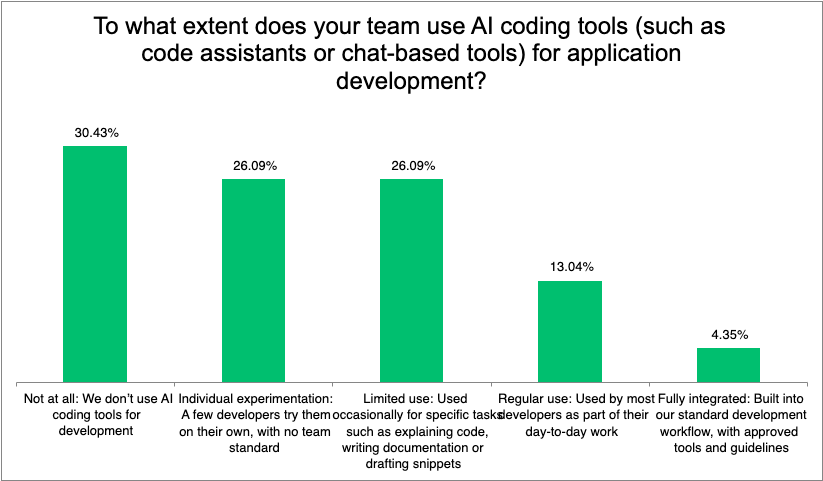
Most shops are using AI coding tools, but few have made them standard.
Seven respondents said they don’t use AI coding tools for development at all. Six described individual experimentation, where a few developers try tools on their own with no team standard, and another six reported limited use for specific tasks like explaining code, writing documentation or drafting snippets. Just three said most of their developers use AI coding tools as part of their day-to-day work, and only one reported that the tools are fully integrated into the standard development workflow, with approved tools and guidelines. In all, 16 of 23 respondents reported at least some AI coding tool activity, but only four described regular or fully integrated use.
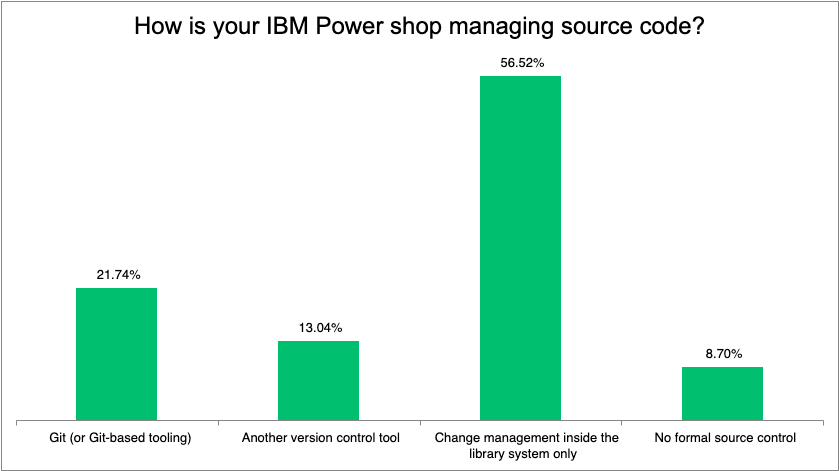
Library-based change management is still the norm for source control.
Asked how their IBM Power shop manages source code, 13 respondents—more than half—said they rely on change management inside the library system only. Five said they use Git or Git-based tooling and three use another version control tool. Two respondents reported no formal source control at all. Taken together, 15 of 23 respondents don’t have a dedicated version control tool in place.
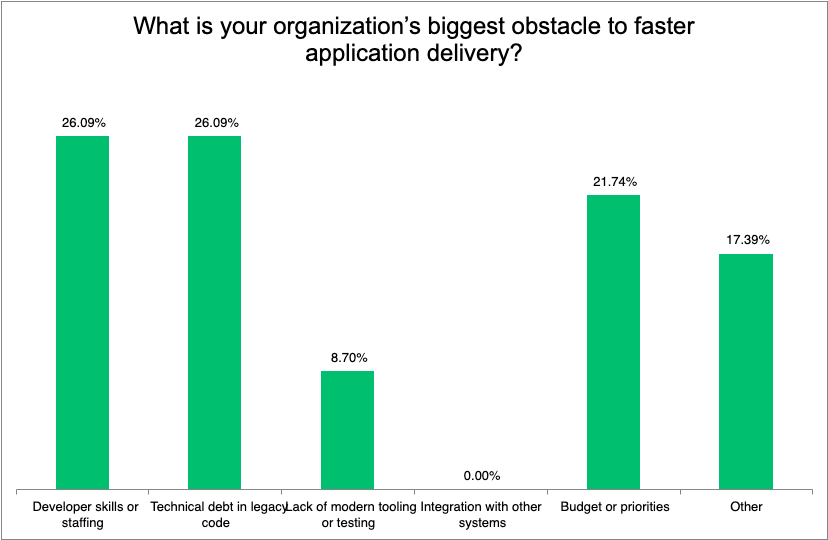
Skills, technical debt and priorities top the list of delivery obstacles.
Developer skills or staffing and technical debt in legacy code tied for the biggest obstacle to faster application delivery, with six respondents choosing each. Budget or priorities followed with five, while four chose “other” and two pointed to a lack of modern tooling or testing. No respondent selected integration with other systems. The skills-and-debt pairing accounts for 12 of 23 responses, a reminder that the constraints on delivery speed are as much about people and legacy code as they are about tools.
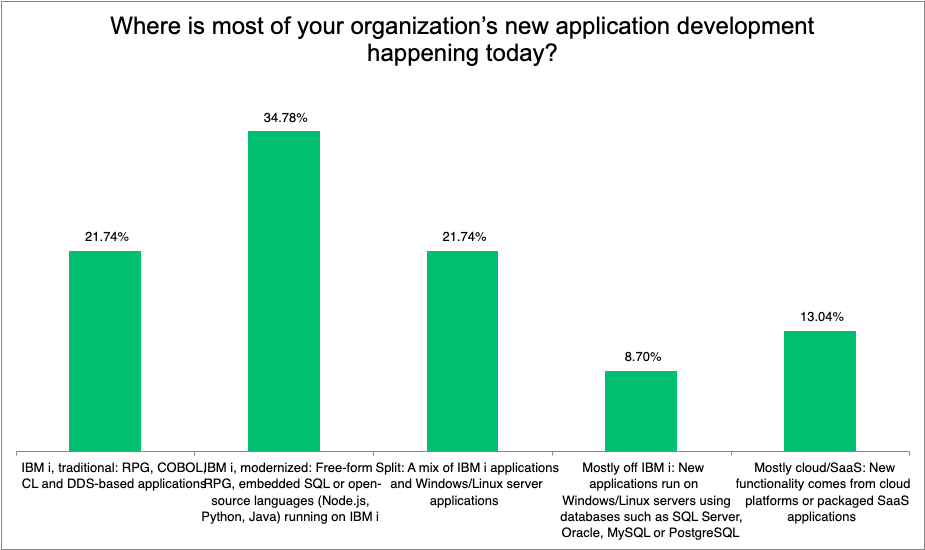
New development is split between modernized IBM i and other platforms.
Eight respondents said most new application development happens on IBM i using modernized approaches, such as free-form RPG, embedded SQL or open-source languages like Node.js, Python and Java. Five said new development is still mostly traditional IBM i (RPG, COBOL, CL and DDS), and five described a split between IBM i and Windows/Linux server applications. Three reported that new functionality mostly comes from cloud or SaaS platforms, and two said new applications mostly run on Windows/Linux servers. Combined, 13 of 23 respondents are doing most of their new development on IBM i, whether traditional or modernized.
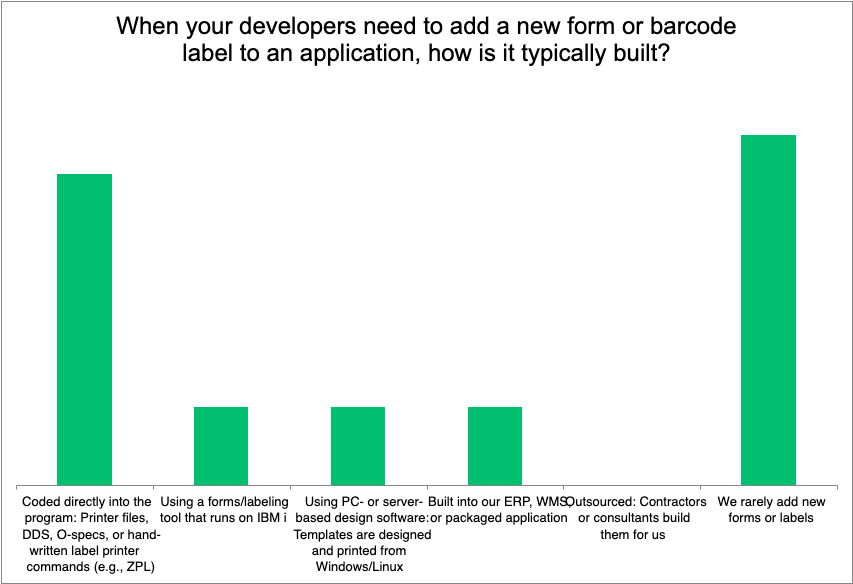
When it comes to forms and labels, most shops either code them by hand or rarely touch them.
In the most common answer, nine respondents said they rarely add new forms or labels. Eight said new forms and labels are coded directly into the program, using printer files, DDS, O-specs or hand-written label printer commands such as ZPL. Two respondents each said they use a forms or labeling tool that runs on IBM i, PC- or server-based design software, or functionality built into their ERP, WMS or packaged application. No one said they outsource the work. Among the 14 respondents who do add new forms or labels, eight build them by coding directly.
This report was generated with AI assistance.